


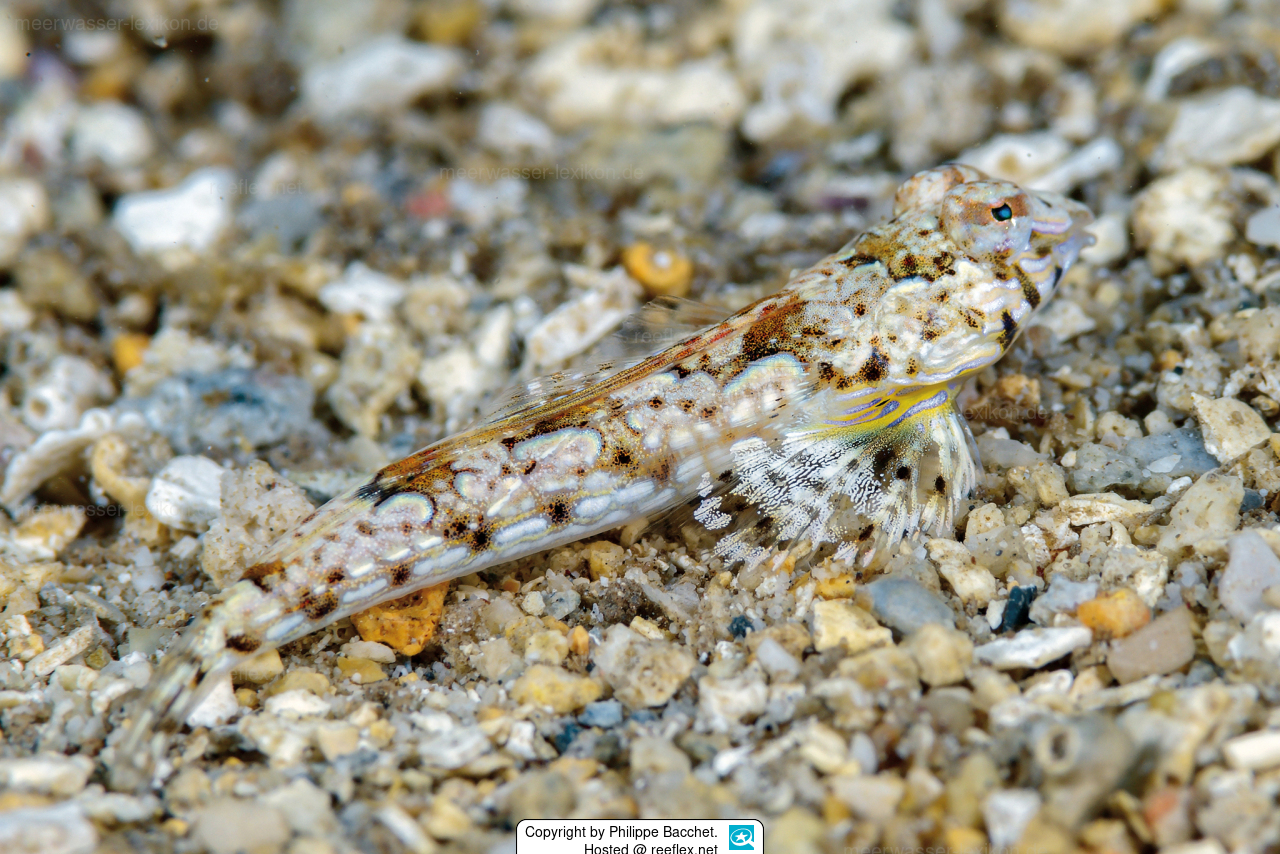
 Philippe Bacchet, Tahiti, Französisch-Polynesien


Info
Synchiropus laddi is found in small groups among algae or low green algae growth on sandy or gravelly bottoms in intertidal zones—and thus in fairly warm and well-circulated waters.
The IUCN Red List of Threatened Species most recently confirmed in 2022 that the species is classified as “Least Concern” and that the lyrefish is available in the marine ornamental fish trade.
Currently, the lyretail is not available from either DeJong Marine Life or Aqzeno, and we have not yet seen it in stores.
In the event that the lyretail becomes available for purchase, it is essential to ensure that this small fish is not eaten as a snack by larger tankmates; in other words, it requires peaceful and appropriately sized tankmates.
Synchiropus laddi is, in any case, a very peaceful fish with a magnificent brown-beige coloration and an interesting pattern of orange, yellow, and brownish spots that partially blend into one another.
The pygmy lyretail’s pectoral fins are white.
Synchiropus laddi has artistically shaped pectoral and dorsal fins with radiating patterns, as well as a characteristic small mouth adapted for feeding on small bottom-dwelling organisms.
Males have a significantly longer first dorsal fin than females.
To keep small animals like Synchiropus laddi healthy and active, they should be fed several small meals a day.
In honor of geologist Harry Stephen Ladd (1899-1982), U.S. Geological Survey, who was at Bikini Atoll, Marshall Islands (type locality), during Operations Crossroads (1946 and again in 1947), studying effects of atomic bombs
We would like to extend our special thanks to Philippe Bacchet from Tahiti, who was able to photograph Synchiropus laddi on a gravel substrate.
The IUCN Red List of Threatened Species most recently confirmed in 2022 that the species is classified as “Least Concern” and that the lyrefish is available in the marine ornamental fish trade.
Currently, the lyretail is not available from either DeJong Marine Life or Aqzeno, and we have not yet seen it in stores.
In the event that the lyretail becomes available for purchase, it is essential to ensure that this small fish is not eaten as a snack by larger tankmates; in other words, it requires peaceful and appropriately sized tankmates.
Synchiropus laddi is, in any case, a very peaceful fish with a magnificent brown-beige coloration and an interesting pattern of orange, yellow, and brownish spots that partially blend into one another.
The pygmy lyretail’s pectoral fins are white.
Synchiropus laddi has artistically shaped pectoral and dorsal fins with radiating patterns, as well as a characteristic small mouth adapted for feeding on small bottom-dwelling organisms.
Males have a significantly longer first dorsal fin than females.
To keep small animals like Synchiropus laddi healthy and active, they should be fed several small meals a day.
In honor of geologist Harry Stephen Ladd (1899-1982), U.S. Geological Survey, who was at Bikini Atoll, Marshall Islands (type locality), during Operations Crossroads (1946 and again in 1947), studying effects of atomic bombs
We would like to extend our special thanks to Philippe Bacchet from Tahiti, who was able to photograph Synchiropus laddi on a gravel substrate.

