


 Raphaël Forns, Kanada


Info
Merulina cylindrica (Milne-Edwards & Haime, 1848)
Clay Bryce from the Aquatic Zoology Western Australian Muesum did take a wonderfull photo of a juvenile colony, showing detail of septo-costae.
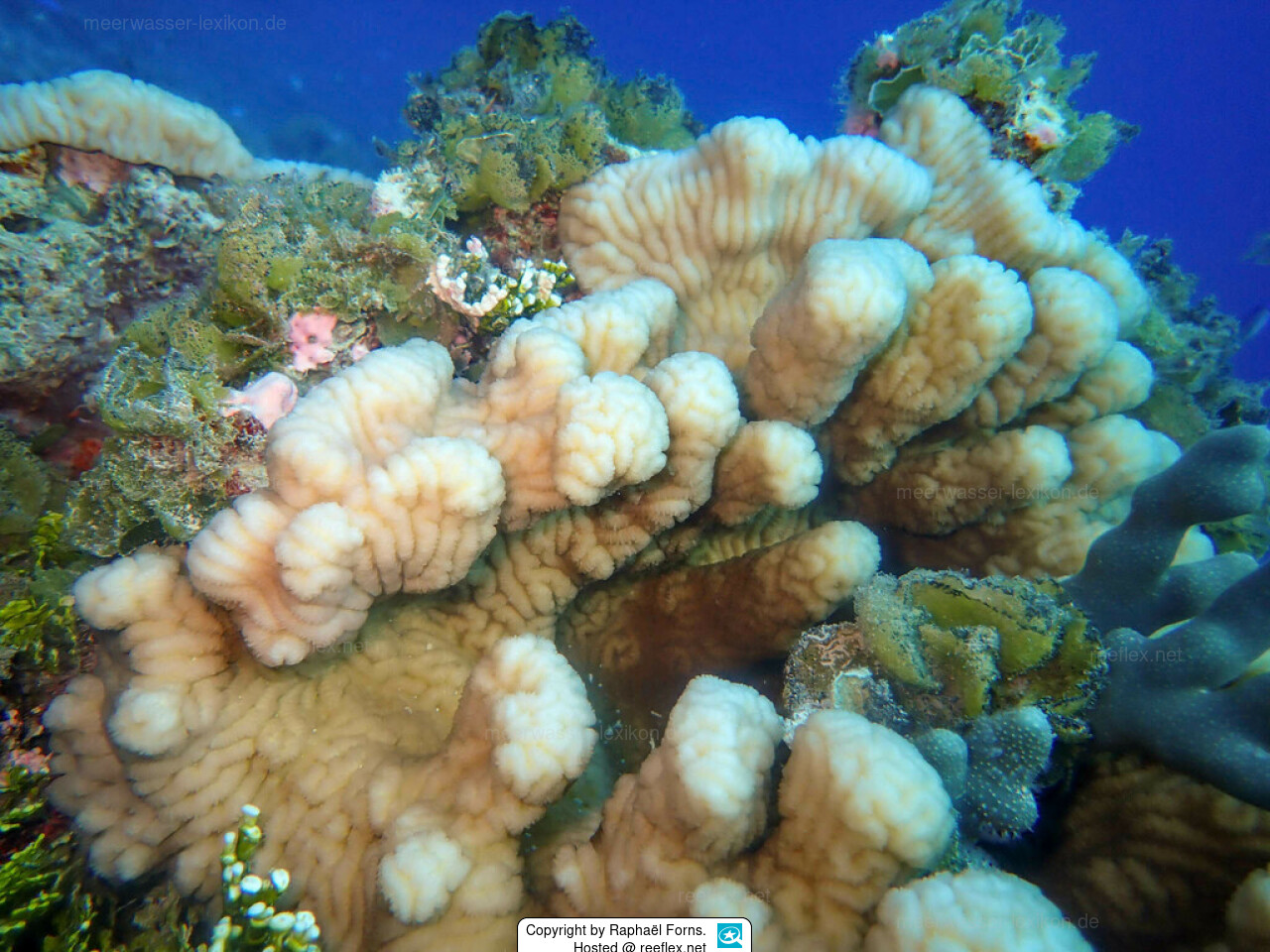
Colonies have thick laminar bases and blunt-ended columns which occasionally branch. Valleys are meandroid and sinuous. Septa are thick and fuse irregularly with each other and with the columellae. Columellae are composed of a few thick septal teeth. Tentacles are usually extended only at night and are long, tapering, and of uniform length.
Colour: Usually cream or yellow-brown.
Habitat: Usually found in partly turbid water such as around fringing reefs and in lagoons.
Abundance: Uncommon.
Similar species: Dendrogyra cylindrus, Leptoria irregularis.
This species is usually found in most reef environments. This species is found from 2-25 m
Text source: Corals of the World by
Synonymised names
Merulina cylindricus (Milne Edwards & Haime, 1849) · unaccepted > misspelling - incorrect original spelling
Merulina studeri Bedot, 1907 · unaccepted > junior subjective synonym
Scapophyllia cylindrica Milne Edwards & Haime, 1849 · unaccepted > superseded combination (basionym)
Clay Bryce from the Aquatic Zoology Western Australian Muesum did take a wonderfull photo of a juvenile colony, showing detail of septo-costae.
Colonies have thick laminar bases and blunt-ended columns which occasionally branch. Valleys are meandroid and sinuous. Septa are thick and fuse irregularly with each other and with the columellae. Columellae are composed of a few thick septal teeth. Tentacles are usually extended only at night and are long, tapering, and of uniform length.
Colour: Usually cream or yellow-brown.
Habitat: Usually found in partly turbid water such as around fringing reefs and in lagoons.
Abundance: Uncommon.
Similar species: Dendrogyra cylindrus, Leptoria irregularis.
This species is usually found in most reef environments. This species is found from 2-25 m
Text source: Corals of the World by
Synonymised names
Merulina cylindricus (Milne Edwards & Haime, 1849) · unaccepted > misspelling - incorrect original spelling
Merulina studeri Bedot, 1907 · unaccepted > junior subjective synonym
Scapophyllia cylindrica Milne Edwards & Haime, 1849 · unaccepted > superseded combination (basionym)


