

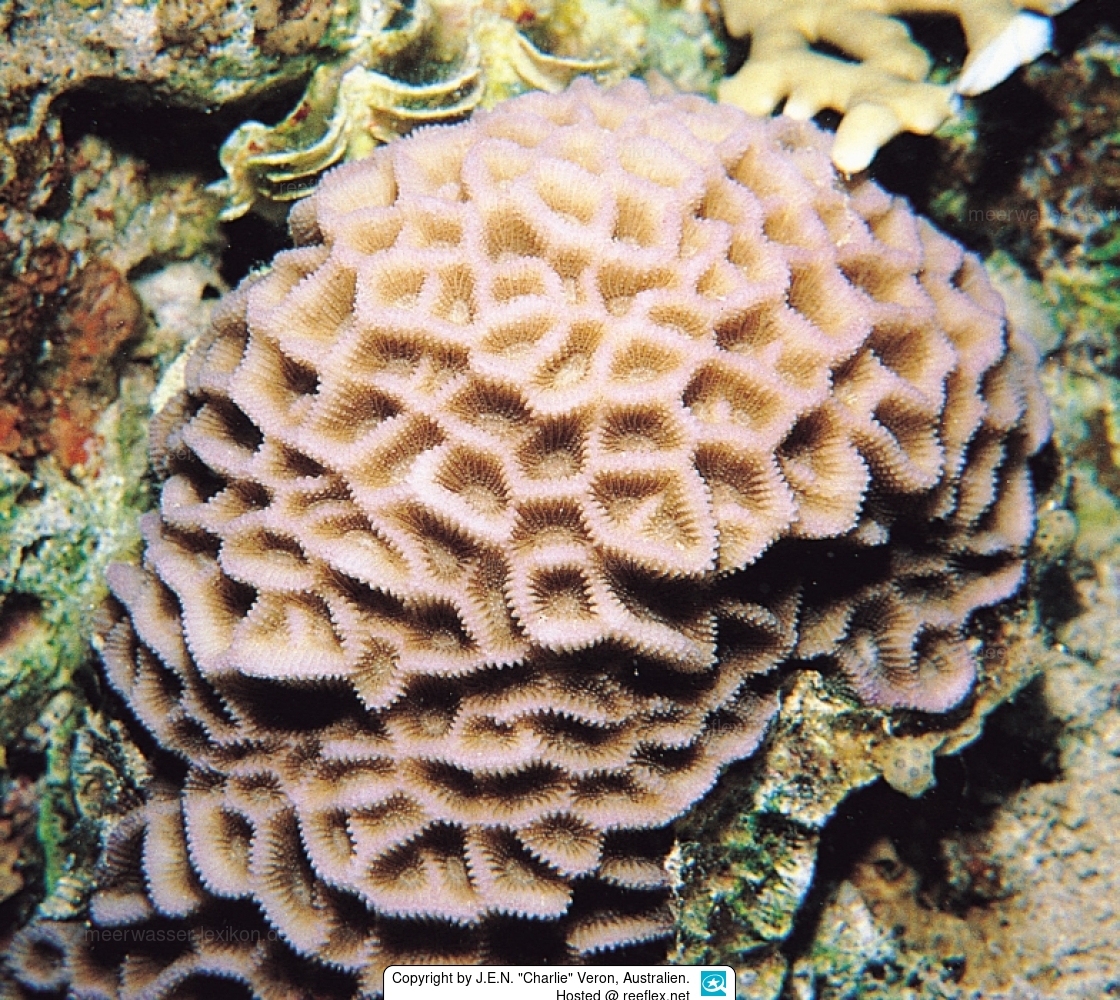
 Dr. John Edward Norwood "Charlie" Veron, Australien


Info
Paramontastraea peresi (Faure and Pichon, 1978)
“From Veron, J.E.N. Corals of the World.”
Characters: Colonies are encrusting and helmet-shaped, with neatly scalloped lower margins. Corallites are angular and characteristically aligned in short shallow radiating valleys at the colony margin. Septa are strongly beaded. A small neat paliform crown is usually present. Budding is both intra- and extratentacular.
Colour: Pinkish-tan.
Habitat: Shallow reef environments.
Abundance: Common.
Similar species: Favites abdita , Goniastrea aspera , Goniastrea palauensis
Taxonomic note: Previous authors have placed this species in Favites. Source reference: Veron (2000). Taxonomic reference: Scheer and Pillai (1983, as Favites peresi). Additional identification guide: Sheppard and Sheppard (1991), Coles (1996), (both as Favites peresi).
Synonymised names
Favites peresi Faure & Pichon, 1978 · unaccepted > superseded combination (basionym)
Goniastrea peresi (Faure & Pichon, 1978) · unaccepted > superseded combination
“From Veron, J.E.N. Corals of the World.”
Characters: Colonies are encrusting and helmet-shaped, with neatly scalloped lower margins. Corallites are angular and characteristically aligned in short shallow radiating valleys at the colony margin. Septa are strongly beaded. A small neat paliform crown is usually present. Budding is both intra- and extratentacular.
Colour: Pinkish-tan.
Habitat: Shallow reef environments.
Abundance: Common.
Similar species: Favites abdita , Goniastrea aspera , Goniastrea palauensis
Taxonomic note: Previous authors have placed this species in Favites. Source reference: Veron (2000). Taxonomic reference: Scheer and Pillai (1983, as Favites peresi). Additional identification guide: Sheppard and Sheppard (1991), Coles (1996), (both as Favites peresi).
Synonymised names
Favites peresi Faure & Pichon, 1978 · unaccepted > superseded combination (basionym)
Goniastrea peresi (Faure & Pichon, 1978) · unaccepted > superseded combination


