




 Kathleen Boyd


Info
Berthellina quadridens (Mörch, 1863)
Side-gilled slugs (family Pleurobranchoidea) have a soft body and a small shell or no shell at all. Their gills are usually clearly visible on the right side of the body, but can also be covered by the mantle. Some species grow very large. Side-gilled slugs are mostly nocturnal. Many produce acidic secretions to defend themselves against predators.
The type locality for the description of Berthellina quadridens is Saint Thomas, U.S. Virgin Islands.
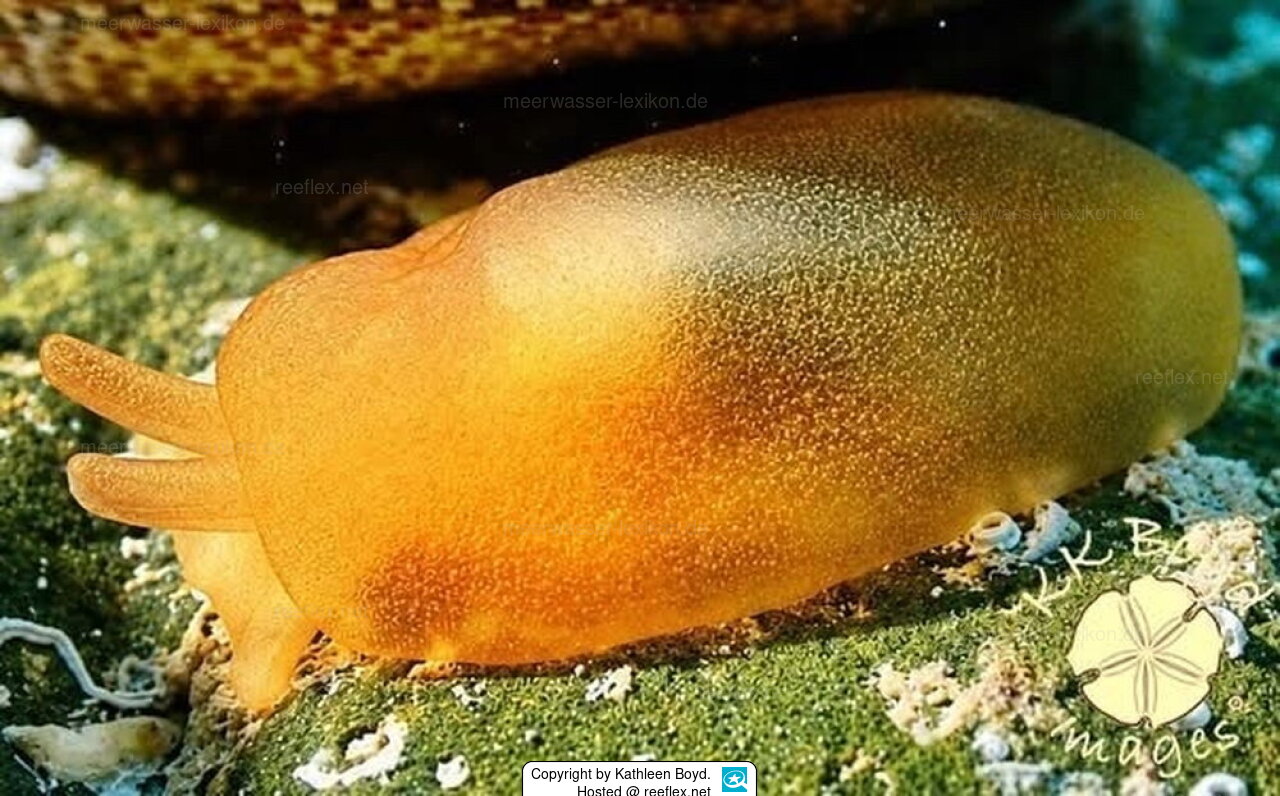
The body is oval and inflated. The notum is smooth and covers the internal shell, which lies above the front part of the viscera. At the front end of the body there is a large oral veil. The rhinophores are rolled and emerge between the oral veil and the notum.
The colouration ranges from yellow to orange, and the animal is also semi-transparent.
Members of the genus Berthellina are thought to be specialist feeders on certain sponges. Some also feed on coral polyps. Berthellina quadridens probably feeds on sponges and likely on the corals Orbicella faveolata and Orbicella annularis, as well as on sea anemones.
Synonymised names
Berthella quadridens Mörch, 1863 · unaccepted (original combination)
Side-gilled slugs (family Pleurobranchoidea) have a soft body and a small shell or no shell at all. Their gills are usually clearly visible on the right side of the body, but can also be covered by the mantle. Some species grow very large. Side-gilled slugs are mostly nocturnal. Many produce acidic secretions to defend themselves against predators.
The type locality for the description of Berthellina quadridens is Saint Thomas, U.S. Virgin Islands.
The body is oval and inflated. The notum is smooth and covers the internal shell, which lies above the front part of the viscera. At the front end of the body there is a large oral veil. The rhinophores are rolled and emerge between the oral veil and the notum.
The colouration ranges from yellow to orange, and the animal is also semi-transparent.
Members of the genus Berthellina are thought to be specialist feeders on certain sponges. Some also feed on coral polyps. Berthellina quadridens probably feeds on sponges and likely on the corals Orbicella faveolata and Orbicella annularis, as well as on sea anemones.
Synonymised names
Berthella quadridens Mörch, 1863 · unaccepted (original combination)


