


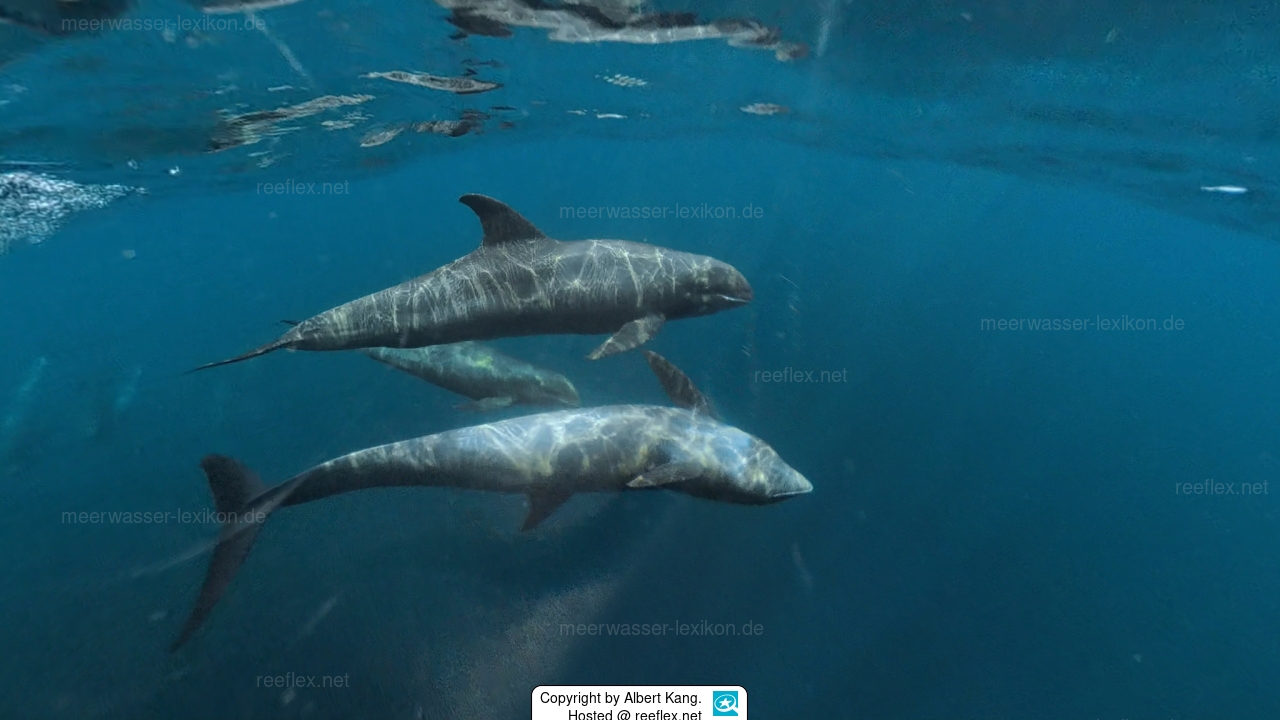
 Albert Kang, Philippinen

Info
Peponocephala electra is a dolphin that lives in social groups and is considered a nocturnal hunter that feeds on a variety of mesopelagic fish, squid, and shrimp (Spitz et al. 2011, West et al. 2018).
Very large aggregations of 1,000 to 2,000 individuals have even been observed, which usually consist of a temporary amalgamation of smaller groups (Brownell et al. 2009).
Broad-snouted dolphins frequently associate with other species, such as Fraser’s dolphins (Lagenodelphis hosei) and short-finned pilot whales (Globicephala macrorhynchus) (Dolar et al. 2006; Kiszka et al. 2011).
It is known that some melon-headed whales are caught in purse seine and driftnet fisheries, and some are killed during drive hunts in Japan as well as in other targeted fisheries in tropical regions around the world.
Several individuals of this species have been captured for display in marine parks.
https://www.fao.org/4/t0725e/t0725e20.pdf
This dolphin’s body is typically dark gray to black, with white lips and a white patch in the genital region.
The black, triangular “mask” on its face distinguishes melon-headed whales from the more uniformly colored pygmy orcas.
Also, the dark “cape” on the melon-headed whale extends significantly further below the dorsal fin than on the dwarf orca, although the boundary is often only faintly visible.
A light-colored stripe runs from the blowhole to the tip of the snout, widening toward the front.
Predators: large sharks and orcas
Synonyms:
Delphinus (Lagenorhynchus) fusiformis Owen, 1866 · unaccepted (synonym)
Delphinus pectoralis Peale, 1848 · unaccepted (synonym)
Electra asia Gray, 1868 · unaccepted (synonym)
Electra electra Nakajima & Nishiwaki, 1965 · unaccepted (synonym)
Electra fusiformis Gray, 1868 · unaccepted (synonym)
Electra obtusa Gray, 1868 · unaccepted (synonym)
Lagenorhynchus asia Gray, 1846 · unaccepted (synonym)
Lagenorhynchus electra Gray, 1846 · unaccepted (basionym)
Lagenorhynchus pectoralis Cassin, 1858 · unaccepted (synonym)
Very large aggregations of 1,000 to 2,000 individuals have even been observed, which usually consist of a temporary amalgamation of smaller groups (Brownell et al. 2009).
Broad-snouted dolphins frequently associate with other species, such as Fraser’s dolphins (Lagenodelphis hosei) and short-finned pilot whales (Globicephala macrorhynchus) (Dolar et al. 2006; Kiszka et al. 2011).
It is known that some melon-headed whales are caught in purse seine and driftnet fisheries, and some are killed during drive hunts in Japan as well as in other targeted fisheries in tropical regions around the world.
Several individuals of this species have been captured for display in marine parks.
https://www.fao.org/4/t0725e/t0725e20.pdf
This dolphin’s body is typically dark gray to black, with white lips and a white patch in the genital region.
The black, triangular “mask” on its face distinguishes melon-headed whales from the more uniformly colored pygmy orcas.
Also, the dark “cape” on the melon-headed whale extends significantly further below the dorsal fin than on the dwarf orca, although the boundary is often only faintly visible.
A light-colored stripe runs from the blowhole to the tip of the snout, widening toward the front.
Predators: large sharks and orcas
Synonyms:
Delphinus (Lagenorhynchus) fusiformis Owen, 1866 · unaccepted (synonym)
Delphinus pectoralis Peale, 1848 · unaccepted (synonym)
Electra asia Gray, 1868 · unaccepted (synonym)
Electra electra Nakajima & Nishiwaki, 1965 · unaccepted (synonym)
Electra fusiformis Gray, 1868 · unaccepted (synonym)
Electra obtusa Gray, 1868 · unaccepted (synonym)
Lagenorhynchus asia Gray, 1846 · unaccepted (synonym)
Lagenorhynchus electra Gray, 1846 · unaccepted (basionym)
Lagenorhynchus pectoralis Cassin, 1858 · unaccepted (synonym)

