


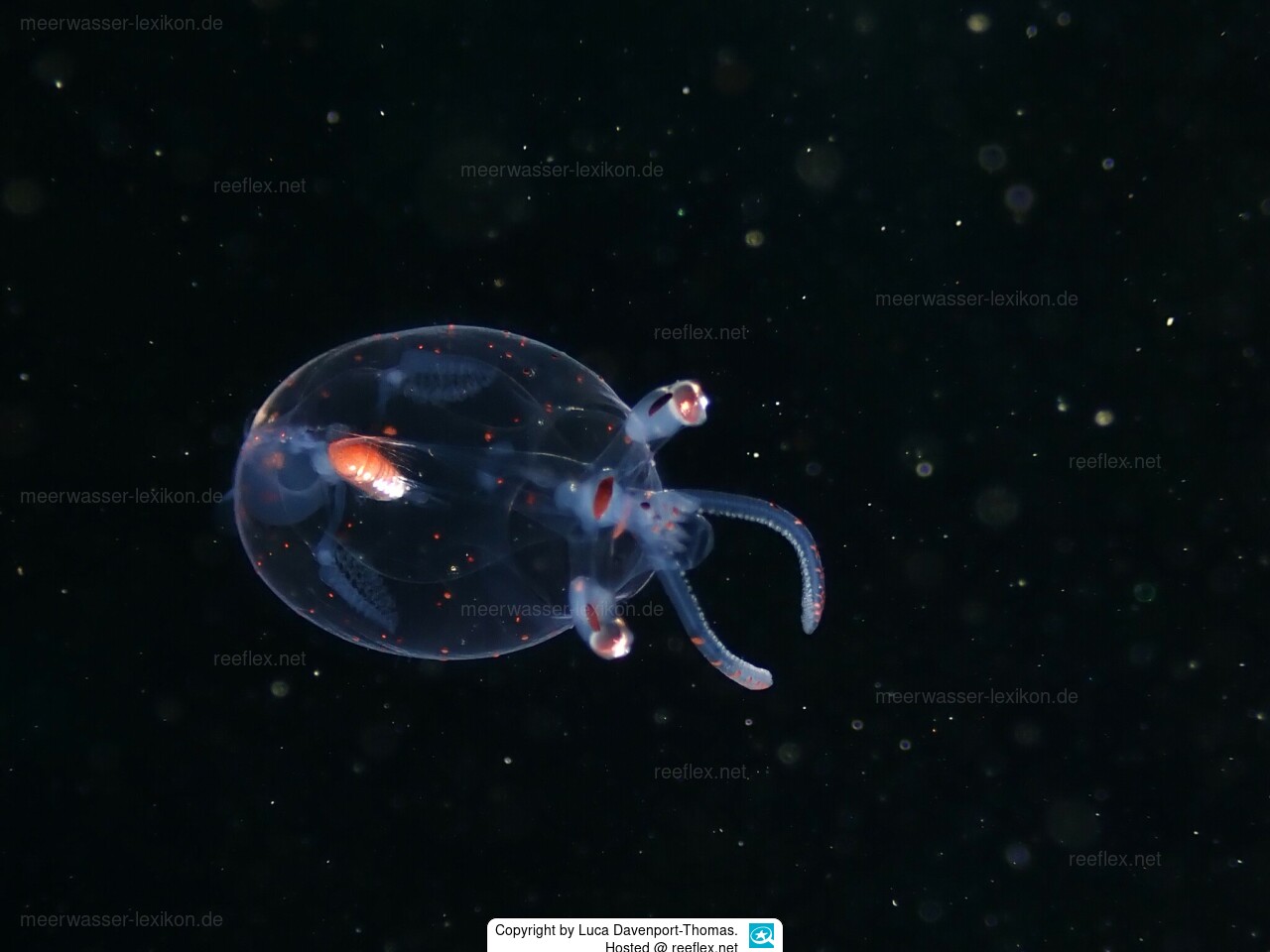
 Luca Davenport-Thomas, Neuseeland


Info
In the oceans, there is an unwritten law: eat or be eaten—and this applies to the entire food chain.
To avoid falling prey to every predator, marine life has developed a wide variety of protective measures over thousands of years; here are just a few examples:
- Use of poisons and toxins, and signaling their toxicity through color
- Camouflage, adaptation to the environment
- Symbiosis with hosts that have strong defenses (clownfish & sea anemone)
- Mimicry
- High escape speeds
- Development of hard shells, carapaces, spines, and thorns
- Use of visual distractions (ink in squid)
- Development of translucent or transparent bodies
- Development of false eyes to confuse predators
- Development of massive bodies (whales)
- Inflating the body
- Secretion of body mucus, formation of mucus cocoons
- Use of hiding places in reef crevices
- Behavioral adaptations such as playing dead
- Adaptations of the eyes to detect predators early
- Burying themselves in sedimentary substrates
- Active defense (through biting, stinging)
and many other methods
Teuthowenia pelluci, a glass squid with bulging eyes (scientific name: Teuthowenia pelluci), is a unique species of glass squid. It lives in the depths of the ocean and has evolved to be almost completely transparent over many years and generations.
This rare animal is found in the oceans around the Southern Hemisphere at depths of up to 2,400 meters.
The glass squid with the big, round eyes is a unique animal with a blue, transparent body.
This squid is famous for its large eyes, which look a bit like “googly eyes”!
Its body wall, known as the mantle, is paper-thin. It is only a few millimeters thick. Female squids are generally slightly larger than males. This squid has eight short tentacles. It also has two slightly longer tentacles at the end of its body.
Its internal organs are barely visible through its transparent body. The only clearly visible organ is its digestive gland. This gland resembles the liver of other animals.
The glass squid with the googly eyes has several ways to protect itself.
If a predator approaches, it can Teuthowenia pelluci suck up a lot of water.
This causes its body to swell, making it look much larger—in other words, it tries to deter enemies by appearing more threatening due to its increased size.
The glass squid with its bulging eyes is a blue, transparent organism about 200 mm in length with strikingly large eyes.
Its mantle is only a few millimeters thick; females grow slightly larger than males.
This small squid has eight short tentacles and a slightly longer pair at the end of its rather bloated body.
The only visible internal organ is the digestive gland, which resembles the liver of a chordate.
As a defense mechanism, the squid can suck in surrounding water to drastically increase its size and thus appear more threatening.
It is also able to flee from predators using a water jet propulsion system, which means it shoots water out of its body under pressure to quickly dart away!
The cells in the eyes and tentacles of this glass squid form small, bioluminescent organs called photophores.
These organs emit light, making the organism visible in the darkness of the bathyal zone.
This bioluminescence requires energy in the form of adenosine triphosphate (ATP), which the squid obtains by catching prey.
Female squid reach sexual maturity at a size of 150 to 190 mm, while males are sexually mature as early as 140 mm in body length.
Pregnant females carry between 6,000 and 8,000 eggs, each with a diameter of 2.2 mm, inside their bodies; the eggs are often visible through the squid’s thin mantle.
The squid’s eggs are laid in clusters on rocks and plants on the seafloor, and the newly hatched baby squid rapidly develop into paralarvae.
Juvenile squid are most commonly collected at depths between 0 and 200 meters, while older and adult individuals are found in deeper, anoxic waters
We would like to extend our special thanks to Luca Davenport-Thomas for the first photo of Teuthowenia pelluci.
Luca left the following this comment on the photo at iNaturalist:
"An amazing glass squid. When I disturbed it it would tuck in its tentacles and eyes, and even its fins and show big spots. So cool. The area around the brain was brightly iridescent. There are very faint long tubercles around the mantle if that helps with species id.
Really hard to get nice shots with a compact camera sadly.."
Synonyms:
Anomalocranchia impennis G. C. Robson, 1924 · unaccepted > junior subjective synonym
Desmoteuthis pellucida Chun, 1910 · unaccepted (original combination)
Megalocranchia megalops australis G. L. Voss, 1967 · unaccepted
Megalocranchia richardsoni Dell, 1959 · unaccepted (synonym)
To avoid falling prey to every predator, marine life has developed a wide variety of protective measures over thousands of years; here are just a few examples:
- Use of poisons and toxins, and signaling their toxicity through color
- Camouflage, adaptation to the environment
- Symbiosis with hosts that have strong defenses (clownfish & sea anemone)
- Mimicry
- High escape speeds
- Development of hard shells, carapaces, spines, and thorns
- Use of visual distractions (ink in squid)
- Development of translucent or transparent bodies
- Development of false eyes to confuse predators
- Development of massive bodies (whales)
- Inflating the body
- Secretion of body mucus, formation of mucus cocoons
- Use of hiding places in reef crevices
- Behavioral adaptations such as playing dead
- Adaptations of the eyes to detect predators early
- Burying themselves in sedimentary substrates
- Active defense (through biting, stinging)
and many other methods
Teuthowenia pelluci, a glass squid with bulging eyes (scientific name: Teuthowenia pelluci), is a unique species of glass squid. It lives in the depths of the ocean and has evolved to be almost completely transparent over many years and generations.
This rare animal is found in the oceans around the Southern Hemisphere at depths of up to 2,400 meters.
The glass squid with the big, round eyes is a unique animal with a blue, transparent body.
This squid is famous for its large eyes, which look a bit like “googly eyes”!
Its body wall, known as the mantle, is paper-thin. It is only a few millimeters thick. Female squids are generally slightly larger than males. This squid has eight short tentacles. It also has two slightly longer tentacles at the end of its body.
Its internal organs are barely visible through its transparent body. The only clearly visible organ is its digestive gland. This gland resembles the liver of other animals.
The glass squid with the googly eyes has several ways to protect itself.
If a predator approaches, it can Teuthowenia pelluci suck up a lot of water.
This causes its body to swell, making it look much larger—in other words, it tries to deter enemies by appearing more threatening due to its increased size.
The glass squid with its bulging eyes is a blue, transparent organism about 200 mm in length with strikingly large eyes.
Its mantle is only a few millimeters thick; females grow slightly larger than males.
This small squid has eight short tentacles and a slightly longer pair at the end of its rather bloated body.
The only visible internal organ is the digestive gland, which resembles the liver of a chordate.
As a defense mechanism, the squid can suck in surrounding water to drastically increase its size and thus appear more threatening.
It is also able to flee from predators using a water jet propulsion system, which means it shoots water out of its body under pressure to quickly dart away!
The cells in the eyes and tentacles of this glass squid form small, bioluminescent organs called photophores.
These organs emit light, making the organism visible in the darkness of the bathyal zone.
This bioluminescence requires energy in the form of adenosine triphosphate (ATP), which the squid obtains by catching prey.
Female squid reach sexual maturity at a size of 150 to 190 mm, while males are sexually mature as early as 140 mm in body length.
Pregnant females carry between 6,000 and 8,000 eggs, each with a diameter of 2.2 mm, inside their bodies; the eggs are often visible through the squid’s thin mantle.
The squid’s eggs are laid in clusters on rocks and plants on the seafloor, and the newly hatched baby squid rapidly develop into paralarvae.
Juvenile squid are most commonly collected at depths between 0 and 200 meters, while older and adult individuals are found in deeper, anoxic waters
We would like to extend our special thanks to Luca Davenport-Thomas for the first photo of Teuthowenia pelluci.
Luca left the following this comment on the photo at iNaturalist:
"An amazing glass squid. When I disturbed it it would tuck in its tentacles and eyes, and even its fins and show big spots. So cool. The area around the brain was brightly iridescent. There are very faint long tubercles around the mantle if that helps with species id.
Really hard to get nice shots with a compact camera sadly.."
Synonyms:
Anomalocranchia impennis G. C. Robson, 1924 · unaccepted > junior subjective synonym
Desmoteuthis pellucida Chun, 1910 · unaccepted (original combination)
Megalocranchia megalops australis G. L. Voss, 1967 · unaccepted
Megalocranchia richardsoni Dell, 1959 · unaccepted (synonym)

