


 ZooKeys

Info
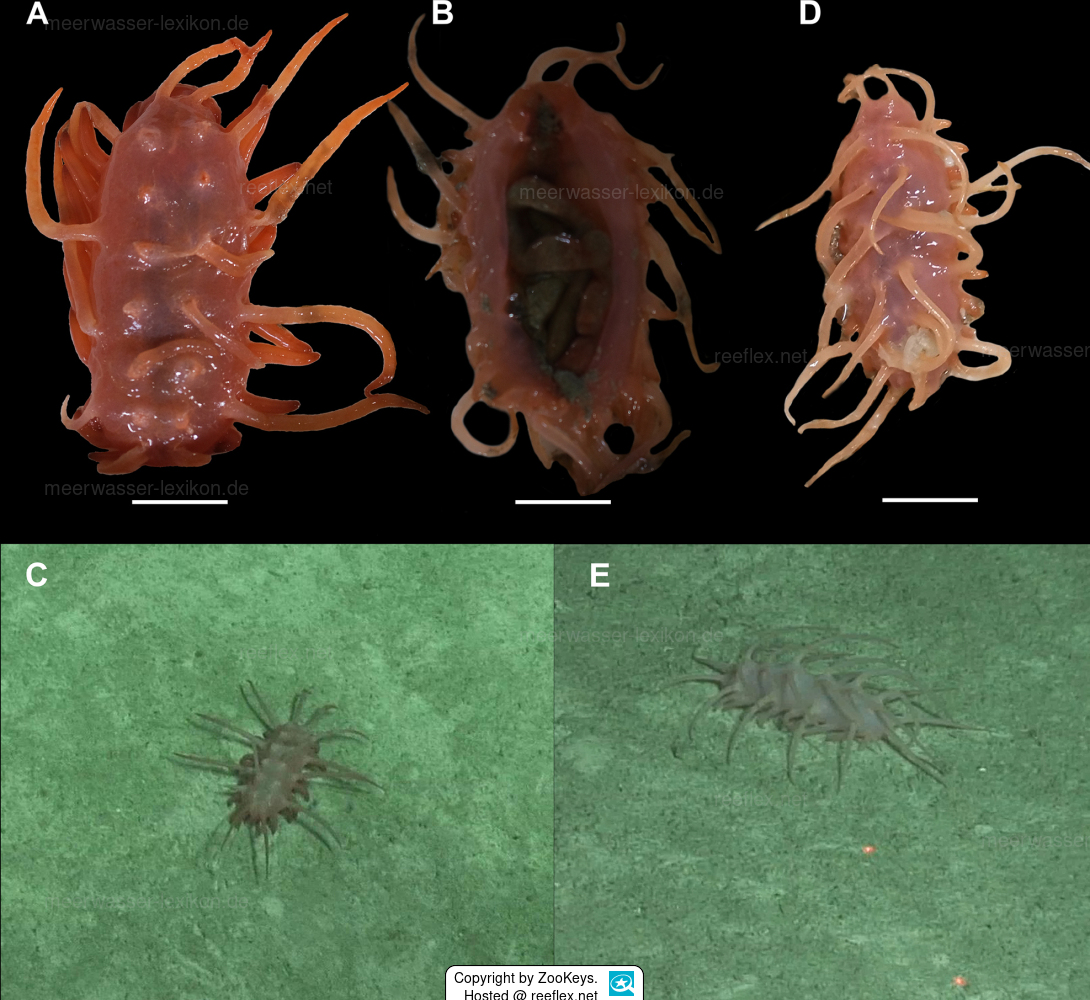
In May 2022, two deep-sea sea cucumber specimens were collected from the Ninety East Ridge in the Indian Ocean using the manned submersible Jiaolong aboard the research vessel ShenHai YiHao; one of them is Deima oloughlini.
The sea cucumber’s body is cylindrical, slightly flattened ventrally; the skin is smooth, and its coloration in vivo ranges from pink to reddish.
The body width is approximately 5–7.5 cm, and the length is approximately 13–17 cm.
The basal diameter of the dorsal papillae is approximately 0.7–0.9 cm, and their length is 6–11 cm.
The dorsal papillae are flesh-pink in color, darker at the tips.
The tube feet are generally darker than the papillae, with red-black tips.
The basal diameter of the tubular feet is approximately 700–1,100 µm, and their length is approximately 1,600–3,500 µm.
The ventral mouth opening is surrounded by a raised, ring-shaped ridge, within which retracted tentacles are visible.
The dorsal papillae are arranged bilaterally symmetrically; there are 6 pairs of slender medial papillae and 6 pairs of longer lateral papillae, all of which are symmetrically arranged.
On both sides of the abdomen there are about 11 ventrolateral tube feet.
The tentacles are retracted; their number is unknown.
The sea cucumber’s body stability is maintained by ossicles, perforated plates, and various rods.
Etymology. Named in honor of our late mentor and friend P. Mark O’Loughlin for his significant contribution to the taxonomy of sea cucumbers.
Reference:
Liao X, Li J, Xu N, Li X, Ge M, Zhang T, Li M, Zhang X, Xu Q (2026) Morphological redescription and complete mitochondrial genome of Deima oloughlini (Holothuroidea, Synallactida, Deimatidae), with a new record from the northern Indian Ocean. ZooKeys 1286: 265–282. https://doi.org/10.3897/zookeys.1286.190382
This is an open-access article distributed under the terms of the Creative Commons Attribution License (CC BY 4.0), which permits unrestricted use, distribution, and reproduction in any medium, provided the original author and source are credited.
The sea cucumber’s body is cylindrical, slightly flattened ventrally; the skin is smooth, and its coloration in vivo ranges from pink to reddish.
The body width is approximately 5–7.5 cm, and the length is approximately 13–17 cm.
The basal diameter of the dorsal papillae is approximately 0.7–0.9 cm, and their length is 6–11 cm.
The dorsal papillae are flesh-pink in color, darker at the tips.
The tube feet are generally darker than the papillae, with red-black tips.
The basal diameter of the tubular feet is approximately 700–1,100 µm, and their length is approximately 1,600–3,500 µm.
The ventral mouth opening is surrounded by a raised, ring-shaped ridge, within which retracted tentacles are visible.
The dorsal papillae are arranged bilaterally symmetrically; there are 6 pairs of slender medial papillae and 6 pairs of longer lateral papillae, all of which are symmetrically arranged.
On both sides of the abdomen there are about 11 ventrolateral tube feet.
The tentacles are retracted; their number is unknown.
The sea cucumber’s body stability is maintained by ossicles, perforated plates, and various rods.
Etymology. Named in honor of our late mentor and friend P. Mark O’Loughlin for his significant contribution to the taxonomy of sea cucumbers.
Reference:
Liao X, Li J, Xu N, Li X, Ge M, Zhang T, Li M, Zhang X, Xu Q (2026) Morphological redescription and complete mitochondrial genome of Deima oloughlini (Holothuroidea, Synallactida, Deimatidae), with a new record from the northern Indian Ocean. ZooKeys 1286: 265–282. https://doi.org/10.3897/zookeys.1286.190382
This is an open-access article distributed under the terms of the Creative Commons Attribution License (CC BY 4.0), which permits unrestricted use, distribution, and reproduction in any medium, provided the original author and source are credited.

