


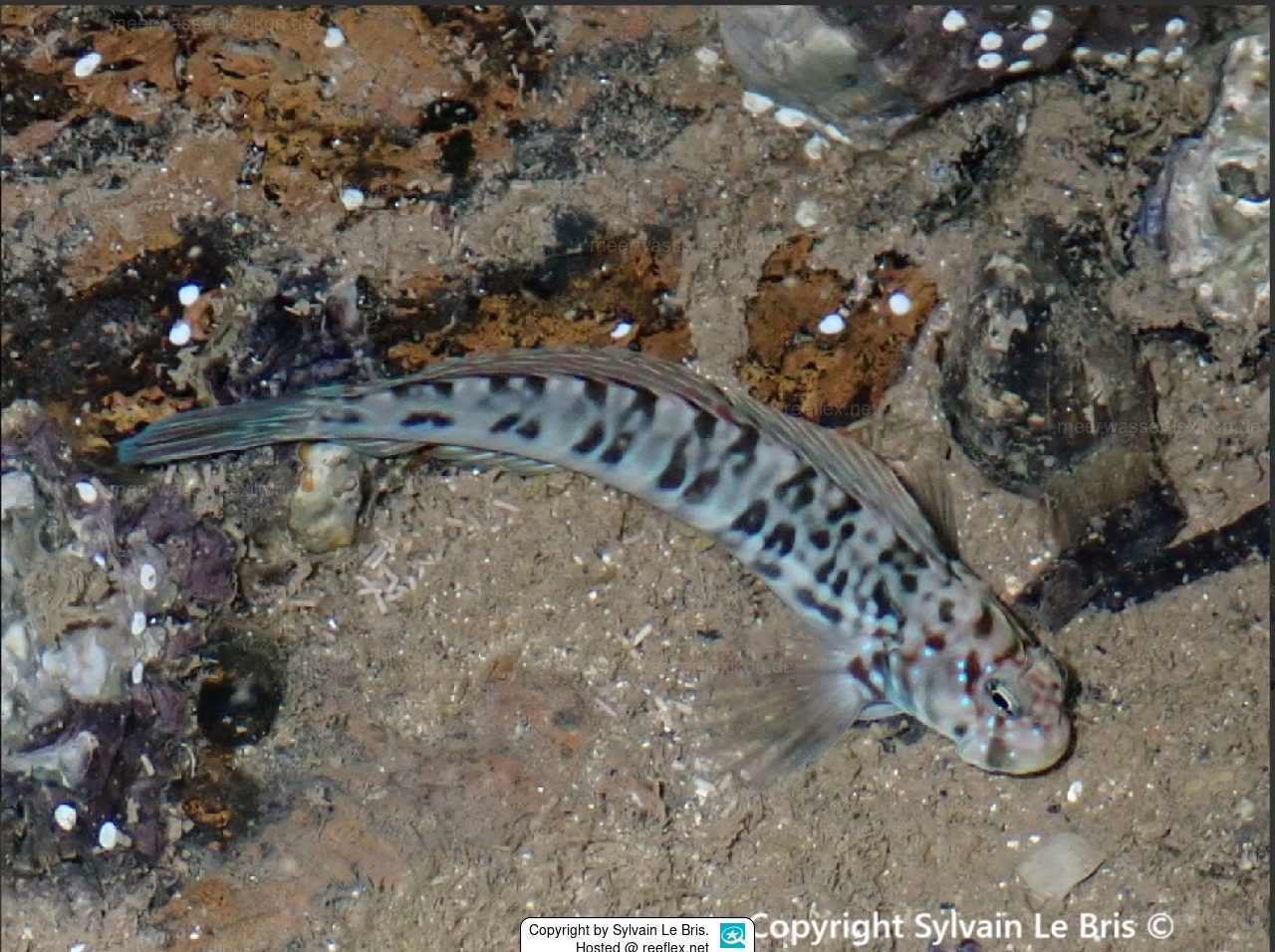
 Sylvain Le Bris, Frankreich


Info
Istiblennius bellus is a very widespread blenny fish that can be found and observed in shallow waters and tidal pools in the Indian Ocean and Indo-Pacific.
The high water temperatures are consistent with shallow water depths.
There are differences in the size data for Istiblennius bellus in the specialist literature. The IUCN Red List states the following:
“The largest male was measured at 12.8 cm (SL), the largest female at 13.1 cm (SL) (Springer and Williams 1994).”
FishBase provides significantly larger data, especially for males
“Maximum length: 16.0 cm SL for males/undetermined maximum length: 13.1 cm SL for females”.
The body of the males is marked with several paired bands.
Dark spots can be seen from the mouth to the neck and rear part of the body, and dark stripes mark the segmented part of the dorsal fin.
Females have dark bands on their bodies
The head, body, and fins (except the pelvic fins) are covered with fine dark spots
Etymology
The genus name “Istiblennius” comes from the Greek istios = sail + blennios = slime
Etymology
The species name “bellus” is Latin for “beautiful,” “pretty,” or “attractive” and describes the appearance of these combtooth blennies.
Synonyms:
Istiblennius bellus impudens Smith, 1959 · unaccepted
Istiblennius impudens Smith, 1959 · unaccepted
Salarias bellus Günther, 1861 · unaccepted
Salarias kellersi Fowler, 1932 · unaccepted
Salarias leopardus Fowler, 1938 · unaccepted
Salarias personatus Fowler, 1945 · unaccepted
The high water temperatures are consistent with shallow water depths.
There are differences in the size data for Istiblennius bellus in the specialist literature. The IUCN Red List states the following:
“The largest male was measured at 12.8 cm (SL), the largest female at 13.1 cm (SL) (Springer and Williams 1994).”
FishBase provides significantly larger data, especially for males
“Maximum length: 16.0 cm SL for males/undetermined maximum length: 13.1 cm SL for females”.
The body of the males is marked with several paired bands.
Dark spots can be seen from the mouth to the neck and rear part of the body, and dark stripes mark the segmented part of the dorsal fin.
Females have dark bands on their bodies
The head, body, and fins (except the pelvic fins) are covered with fine dark spots
Etymology
The genus name “Istiblennius” comes from the Greek istios = sail + blennios = slime
Etymology
The species name “bellus” is Latin for “beautiful,” “pretty,” or “attractive” and describes the appearance of these combtooth blennies.
Synonyms:
Istiblennius bellus impudens Smith, 1959 · unaccepted
Istiblennius impudens Smith, 1959 · unaccepted
Salarias bellus Günther, 1861 · unaccepted
Salarias kellersi Fowler, 1932 · unaccepted
Salarias leopardus Fowler, 1938 · unaccepted
Salarias personatus Fowler, 1945 · unaccepted


