


 Prof. Dr. Bert W. Hoeksema, Holland


Info
Stylasteridae (“filigree corals”) are a family of hydroids closely related to stony corals from the phylum Cnidaria.
Not only do they have a hard, calcareous skeleton, they also do not host zooxanthellate algae in their tissue and are therefore not dependent on the algae for photosynthesis.
They feed by catching small prey, which means that they are not subject to the current “bleaching” and can also live in deep waters.
Distichopora vervoorti feeds by catching small prey, which means that they are not subject to “bleaching” and can also live in deep waters.
During an exploratory dive near Nusa Lembongan, an island off Bali in the Lombok Strait, Indonesia, in July 1997, Dr. Bert Hoeksema encountered a relatively dense population of branching corals in a 1 km long area. The colonies were scattered across a gently sloping slope and arranged in groups under overhanging ridges.
The corals on the slope grew with their blunt branch tips pointing upwards towards the prevailing strong cold water current, while the corals hanging under the outstretched ridges were protected and had relatively thin, longer, and more loosely arranged branches.
The corallum of Distichopora vervoorti is bushy, the holotype consists of about 35 gnarled, blunt branches, most of which originate from a common basal coenosteum, partially covered by epibionts, which originally gave the impression of several separate colonies.
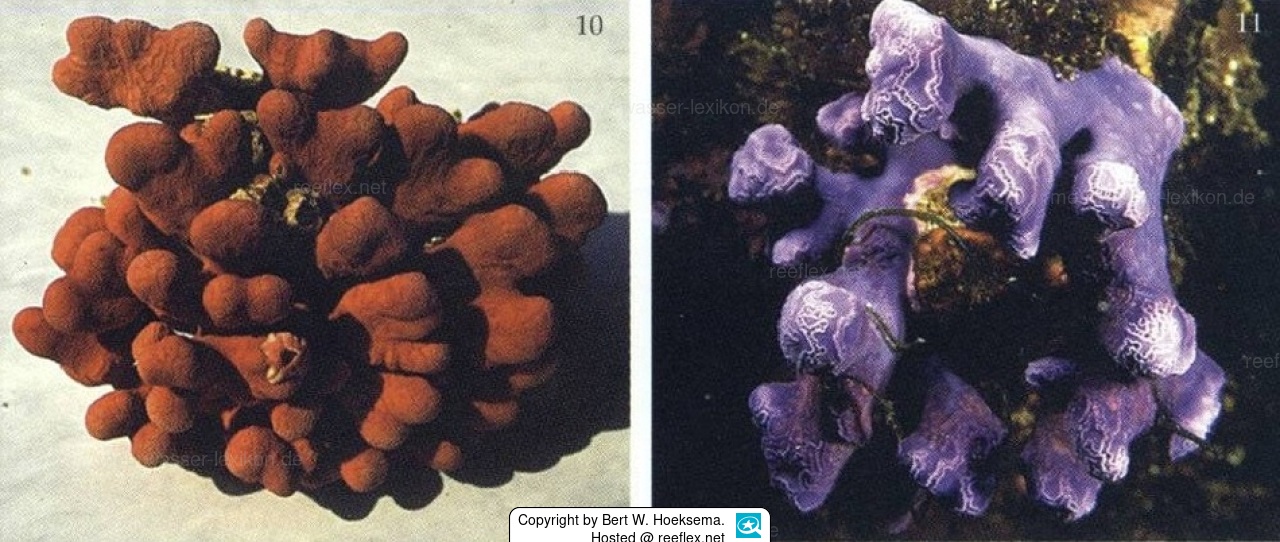
The holotype colony (Fig. 11) has a diameter of about 8.5 cm and a height of 7.5 cm; the branches are thick (5–15 mm in diameter), mostly forked, and rarely anastomosing.
The coenosteum has a net-like, granular texture.
The coloration of the coenostel of Distichopora vervoorti is variable; the holotype and some of the paratypes are red (carmine to ruby red), while other paratypes are orange-yellow.
The branch cores of broken specimens are light, pink or yellow to white.
Other colors of Distichopora vervoorti observed in the sea are mauve, lilac, purple, orange, scarlet, and pink.
The color is found in both their hard skeletons and soft tissue and is retained even after the living tissue has died.
The gastropori responsible for nutrition are closely spaced and circular to slightly elliptical with a diameter of up to 0.29 mm.
Filigree colonies have two types of polyps, dactylozooids and gastrozooids, each specialized in prey capture, defense, and food digestion.
These are “brooding” corals that reproduce not by spreading sperm and eggs, but by fertilization within their special structures, the ampullae. This limits their spread much more than corals whose fertilized eggs are carried away by the current.
Etymology:
This species was named in honor of Prof. Willem Vervoort, who devoted much of his career to better understanding hydrozoans.
Amnerkunge.Alle Fotos stammen von Dr. Stylasteridae (“filigree corals”) are a family of hydroids closely related to stony corals from the phylum Cnidaria.
Not only do they have a hard, calcareous skeleton, they also do not host zooxanthellate algae in their tissue and are therefore not dependent on the algae for photosynthesis.
They feed by catching small prey, which means that they are not subject to the current “bleaching” and can also live in deep waters.
Distichopora vervoorti feeds by catching small prey, which means that they are not subject to “bleaching” and can also live in deep waters.
During an exploratory dive near Nusa Lembongan, an island off Bali in the Lombok Strait, Indonesia, in July 1997, Dr. Bert Hoeksema encountered a relatively dense population of branching corals in a 1 km long area. The colonies were scattered across a gently sloping slope and arranged in groups under overhanging ridges.
The corals on the slope grew with their blunt branch tips pointing upwards towards the prevailing strong cold water current, while the corals hanging under the outstretched ridges were protected and had relatively thin, longer, and more loosely arranged branches.
The corallum of Distichopora vervoorti is bushy, the holotype consists of about 35 gnarled, blunt branches, most of which originate from a common basal coenosteum, partially covered by epibionts, which originally gave the impression of several separate colonies.
The holotype colony (Fig. 11) has a diameter of about 8.5 cm and a height of 7.5 cm; the branches are thick (5–15 mm in diameter), mostly forked, and rarely anastomosing.
The coenosteum has a net-like, granular texture.
The coloration of the coenostel of Distichopora vervoorti is variable; the holotype and some of the paratypes are red (carmine to ruby red), while other paratypes are orange-yellow.
The branch cores of broken specimens are light, pink or yellow to white.
Other colors of Distichopora vervoorti observed in the sea are mauve, lilac, purple, orange, scarlet, and pink.
The color is found in both their hard skeletons and soft tissue and is retained even after the living tissue has died.
The gastropori responsible for nutrition are closely spaced and circular to slightly elliptical with a diameter of up to 0.29 mm.
Filigree colonies have two types of polyps, dactylozooids and gastrozooids, each specialized in prey capture, defense, and food digestion.
These are “brooding” corals that reproduce not by spreading sperm and eggs, but by fertilization within their special structures, the ampullae. This limits their spread much more than corals whose fertilized eggs are carried away by the current.
Etymology:
This species was named in honor of Prof. Willem Vervoort, who devoted much of his career to better understanding hydrozoans
Not only do they have a hard, calcareous skeleton, they also do not host zooxanthellate algae in their tissue and are therefore not dependent on the algae for photosynthesis.
They feed by catching small prey, which means that they are not subject to the current “bleaching” and can also live in deep waters.
Distichopora vervoorti feeds by catching small prey, which means that they are not subject to “bleaching” and can also live in deep waters.
During an exploratory dive near Nusa Lembongan, an island off Bali in the Lombok Strait, Indonesia, in July 1997, Dr. Bert Hoeksema encountered a relatively dense population of branching corals in a 1 km long area. The colonies were scattered across a gently sloping slope and arranged in groups under overhanging ridges.
The corals on the slope grew with their blunt branch tips pointing upwards towards the prevailing strong cold water current, while the corals hanging under the outstretched ridges were protected and had relatively thin, longer, and more loosely arranged branches.
The corallum of Distichopora vervoorti is bushy, the holotype consists of about 35 gnarled, blunt branches, most of which originate from a common basal coenosteum, partially covered by epibionts, which originally gave the impression of several separate colonies.
The holotype colony (Fig. 11) has a diameter of about 8.5 cm and a height of 7.5 cm; the branches are thick (5–15 mm in diameter), mostly forked, and rarely anastomosing.
The coenosteum has a net-like, granular texture.
The coloration of the coenostel of Distichopora vervoorti is variable; the holotype and some of the paratypes are red (carmine to ruby red), while other paratypes are orange-yellow.
The branch cores of broken specimens are light, pink or yellow to white.
Other colors of Distichopora vervoorti observed in the sea are mauve, lilac, purple, orange, scarlet, and pink.
The color is found in both their hard skeletons and soft tissue and is retained even after the living tissue has died.
The gastropori responsible for nutrition are closely spaced and circular to slightly elliptical with a diameter of up to 0.29 mm.
Filigree colonies have two types of polyps, dactylozooids and gastrozooids, each specialized in prey capture, defense, and food digestion.
These are “brooding” corals that reproduce not by spreading sperm and eggs, but by fertilization within their special structures, the ampullae. This limits their spread much more than corals whose fertilized eggs are carried away by the current.
Etymology:
This species was named in honor of Prof. Willem Vervoort, who devoted much of his career to better understanding hydrozoans.
Amnerkunge.Alle Fotos stammen von Dr. Stylasteridae (“filigree corals”) are a family of hydroids closely related to stony corals from the phylum Cnidaria.
Not only do they have a hard, calcareous skeleton, they also do not host zooxanthellate algae in their tissue and are therefore not dependent on the algae for photosynthesis.
They feed by catching small prey, which means that they are not subject to the current “bleaching” and can also live in deep waters.
Distichopora vervoorti feeds by catching small prey, which means that they are not subject to “bleaching” and can also live in deep waters.
During an exploratory dive near Nusa Lembongan, an island off Bali in the Lombok Strait, Indonesia, in July 1997, Dr. Bert Hoeksema encountered a relatively dense population of branching corals in a 1 km long area. The colonies were scattered across a gently sloping slope and arranged in groups under overhanging ridges.
The corals on the slope grew with their blunt branch tips pointing upwards towards the prevailing strong cold water current, while the corals hanging under the outstretched ridges were protected and had relatively thin, longer, and more loosely arranged branches.
The corallum of Distichopora vervoorti is bushy, the holotype consists of about 35 gnarled, blunt branches, most of which originate from a common basal coenosteum, partially covered by epibionts, which originally gave the impression of several separate colonies.
The holotype colony (Fig. 11) has a diameter of about 8.5 cm and a height of 7.5 cm; the branches are thick (5–15 mm in diameter), mostly forked, and rarely anastomosing.
The coenosteum has a net-like, granular texture.
The coloration of the coenostel of Distichopora vervoorti is variable; the holotype and some of the paratypes are red (carmine to ruby red), while other paratypes are orange-yellow.
The branch cores of broken specimens are light, pink or yellow to white.
Other colors of Distichopora vervoorti observed in the sea are mauve, lilac, purple, orange, scarlet, and pink.
The color is found in both their hard skeletons and soft tissue and is retained even after the living tissue has died.
The gastropori responsible for nutrition are closely spaced and circular to slightly elliptical with a diameter of up to 0.29 mm.
Filigree colonies have two types of polyps, dactylozooids and gastrozooids, each specialized in prey capture, defense, and food digestion.
These are “brooding” corals that reproduce not by spreading sperm and eggs, but by fertilization within their special structures, the ampullae. This limits their spread much more than corals whose fertilized eggs are carried away by the current.
Etymology:
This species was named in honor of Prof. Willem Vervoort, who devoted much of his career to better understanding hydrozoans


