


 Wiley Online Library


Info
The Caroline Plate is located in the Bismarck Archipelago between New Ireland and New Britain in the northwestern Pacific Ocean and consists of several seamounts informally referred to as “M4,” “M5,” “M6,” and “M7.”
With the help of the remote-controlled submersible FaXian from the research vessel KeXue, samples were collected in 2017 and 2019, which contained six previously unknown deep-sea soft corals. Neoanthomastus elongatus is one of them and originated from Seamount M7.
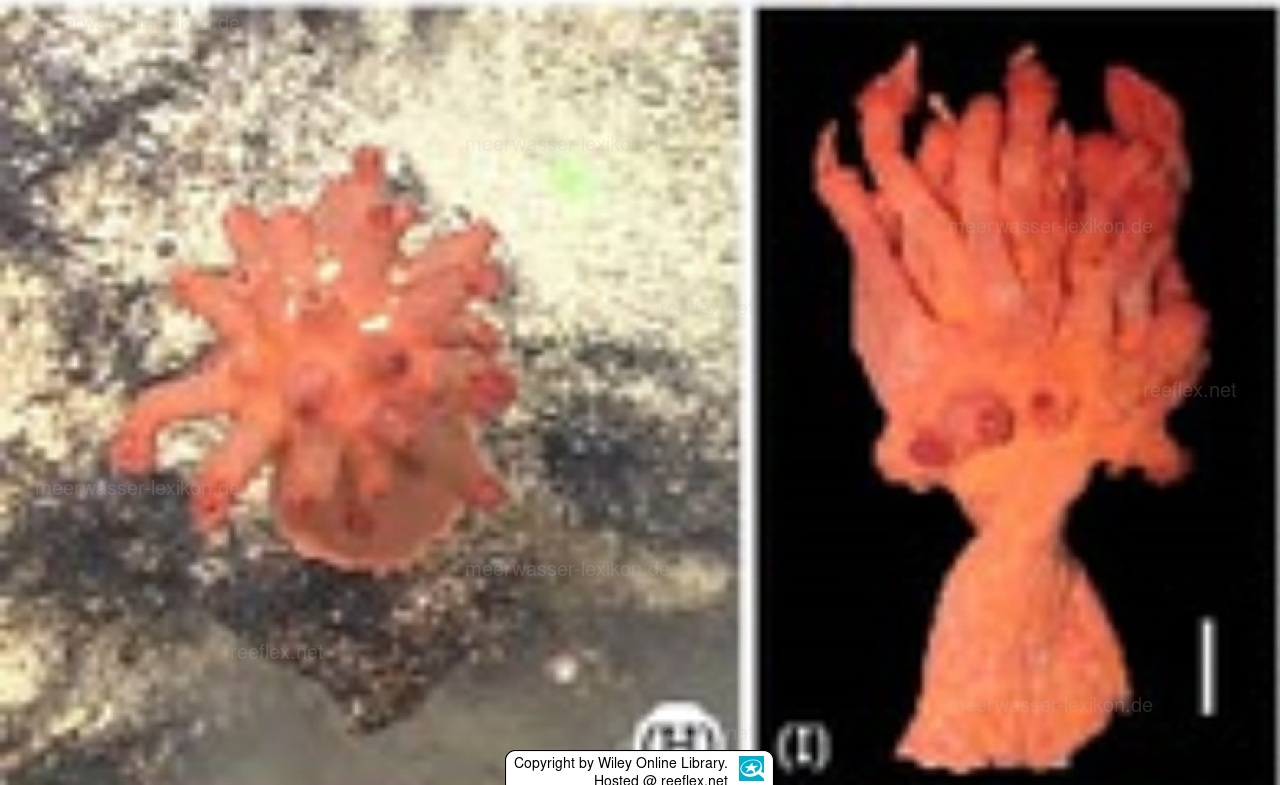
The coral settles on a hard substrate, and the colony is mushroom-shaped with a convex capitulum and an elongated stem.
The tentacles of the autozooids retract into the anthocodiae when disturbed.
The following information was determined from a preserved colony:
- The colony is approximately 150 mm long, and the capitulum bears 29 autozooids.
- The capitulum is convex, approximately 55 mm wide and 90 mm long, and occupies 60% of the total length of the colony.
- The stalk is cylindrical and elongated, approximately 60 mm long and measures 19 mm in diameter at its narrowest point in the middle.
- The adhesive disc is round when alive, irregular when preserved, and measures approximately 25 × 40 mm in width.
- The polyps are dimorphic, the autozooids sterile, evenly distributed throughout the capitulum, mostly slightly contracted, a few retracted into the capitulum.
- The largest polyp is up to 60 mm long and 12 mm wide. The tentacles are contracted, up to 15 mm long and 5 mm wide, with about 25 pairs of pinnules.
- Pinnules up to 2.5 mm long. Some small and developing autozooids appeared in the lowermost part of the capitulum. Siphonozooids are fertile, conspicuous, and numerous, scattered throughout the colony, visible as tiny red protuberances, and usually 0.5 mm wide, smaller than the distance between two of them.
Color:
The colony surface is pink both in vivo and in ethanol preservation; the interior of the colony is white with a reddish area of sclerite accumulation.
The sclerites are translucent to reddish under transmitted light.
Similar species: Neoanthomastus tahinodus (d'Hondt, 1988)
Etymology: The Latin adjective “elongatus” means elongated, referring to the long colony of this species.
Literature reference:
Wiley Onlinelibrary
Yang Li, Junyuan Li, Kuidong Xu,2 025
Mushroom Soft Corals (Octocorallia: Coralliidae) From Seamounts in the Tropical Northwestern Pacific: Morphology and Phylogenetic Analysis Reveal a New Genus and Six New Species
https://doi.org/10.1155/jzs/4177670Digital Object Identifier (DOI)
open access
With the help of the remote-controlled submersible FaXian from the research vessel KeXue, samples were collected in 2017 and 2019, which contained six previously unknown deep-sea soft corals. Neoanthomastus elongatus is one of them and originated from Seamount M7.
The coral settles on a hard substrate, and the colony is mushroom-shaped with a convex capitulum and an elongated stem.
The tentacles of the autozooids retract into the anthocodiae when disturbed.
The following information was determined from a preserved colony:
- The colony is approximately 150 mm long, and the capitulum bears 29 autozooids.
- The capitulum is convex, approximately 55 mm wide and 90 mm long, and occupies 60% of the total length of the colony.
- The stalk is cylindrical and elongated, approximately 60 mm long and measures 19 mm in diameter at its narrowest point in the middle.
- The adhesive disc is round when alive, irregular when preserved, and measures approximately 25 × 40 mm in width.
- The polyps are dimorphic, the autozooids sterile, evenly distributed throughout the capitulum, mostly slightly contracted, a few retracted into the capitulum.
- The largest polyp is up to 60 mm long and 12 mm wide. The tentacles are contracted, up to 15 mm long and 5 mm wide, with about 25 pairs of pinnules.
- Pinnules up to 2.5 mm long. Some small and developing autozooids appeared in the lowermost part of the capitulum. Siphonozooids are fertile, conspicuous, and numerous, scattered throughout the colony, visible as tiny red protuberances, and usually 0.5 mm wide, smaller than the distance between two of them.
Color:
The colony surface is pink both in vivo and in ethanol preservation; the interior of the colony is white with a reddish area of sclerite accumulation.
The sclerites are translucent to reddish under transmitted light.
Similar species: Neoanthomastus tahinodus (d'Hondt, 1988)
Etymology: The Latin adjective “elongatus” means elongated, referring to the long colony of this species.
Literature reference:
Wiley Onlinelibrary
Yang Li, Junyuan Li, Kuidong Xu,2 025
Mushroom Soft Corals (Octocorallia: Coralliidae) From Seamounts in the Tropical Northwestern Pacific: Morphology and Phylogenetic Analysis Reveal a New Genus and Six New Species
https://doi.org/10.1155/jzs/4177670Digital Object Identifier (DOI)
open access

