




 Biogeosciences


Info
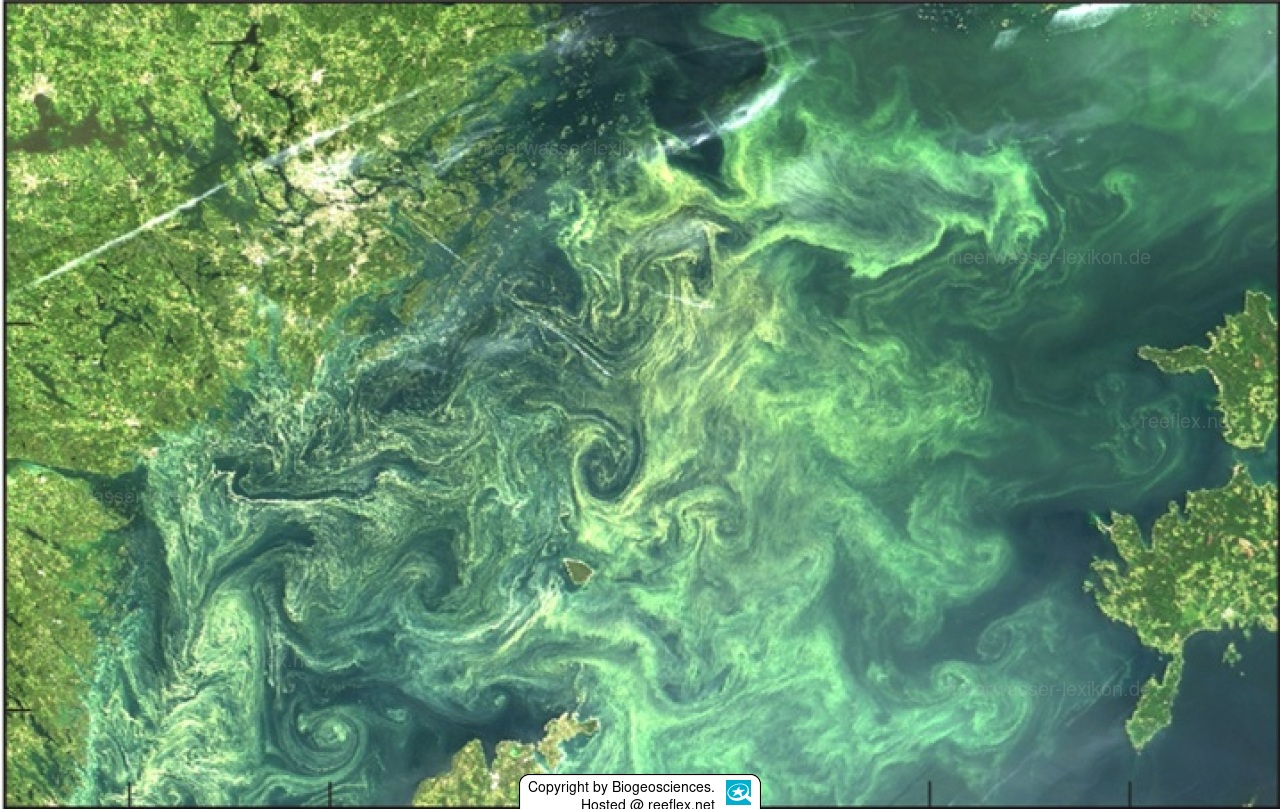
Nodularia spumigena are blue-green, nitrogen-fixing cyanobacteria that thrive in water with high salt content, but also occur in the brackish water of estuaries and in freshwater such as Nevada's Pyramid Lake, USA.
They are characterized by unbranched filaments of very narrow, disc-shaped cells.
The active ingredient of this species is a cyclic pentapeptide, nodularin (liver toxin), which has toxicological effects and has already caused fatal poisoning in ducks, dogs, sheep, pigs, horses, and cattle, as well as mass deaths of fish.
For this reason, not only should farmed animals be kept away from waters with a green, surface layer of bacteria, but humans should also refrain from drinking or bathing in this water (tumor promoter).
In scientific tests, fish larvae of pike and mysis shrimp were fed plankton containing cyanobacteria, which slowed the growth of the pike larvae, while no effects on the growth of the mysids were observed.
Interest in harvesting wild cyanobacteria exists due to the ecological and socioeconomic risks during cyanobacterial blooms in conjunction with the demand for non-terrestrial alternatives for biofuel sources.
Size: 8-16 μm
Biogeosciences, 11, 3619–3633, 2014 www.biogeosciences.net/11/3619/2014/ doi:10.5194/bg-11-3619-2014 ©Author(s) 2014. CC Attribution 3.0 License.
Multidecadal time series of satellite-detected accumulations of cyanobacteria in the Baltic Sea
They are characterized by unbranched filaments of very narrow, disc-shaped cells.
The active ingredient of this species is a cyclic pentapeptide, nodularin (liver toxin), which has toxicological effects and has already caused fatal poisoning in ducks, dogs, sheep, pigs, horses, and cattle, as well as mass deaths of fish.
For this reason, not only should farmed animals be kept away from waters with a green, surface layer of bacteria, but humans should also refrain from drinking or bathing in this water (tumor promoter).
In scientific tests, fish larvae of pike and mysis shrimp were fed plankton containing cyanobacteria, which slowed the growth of the pike larvae, while no effects on the growth of the mysids were observed.
Interest in harvesting wild cyanobacteria exists due to the ecological and socioeconomic risks during cyanobacterial blooms in conjunction with the demand for non-terrestrial alternatives for biofuel sources.
Size: 8-16 μm
Biogeosciences, 11, 3619–3633, 2014 www.biogeosciences.net/11/3619/2014/ doi:10.5194/bg-11-3619-2014 ©Author(s) 2014. CC Attribution 3.0 License.
Multidecadal time series of satellite-detected accumulations of cyanobacteria in the Baltic Sea


