


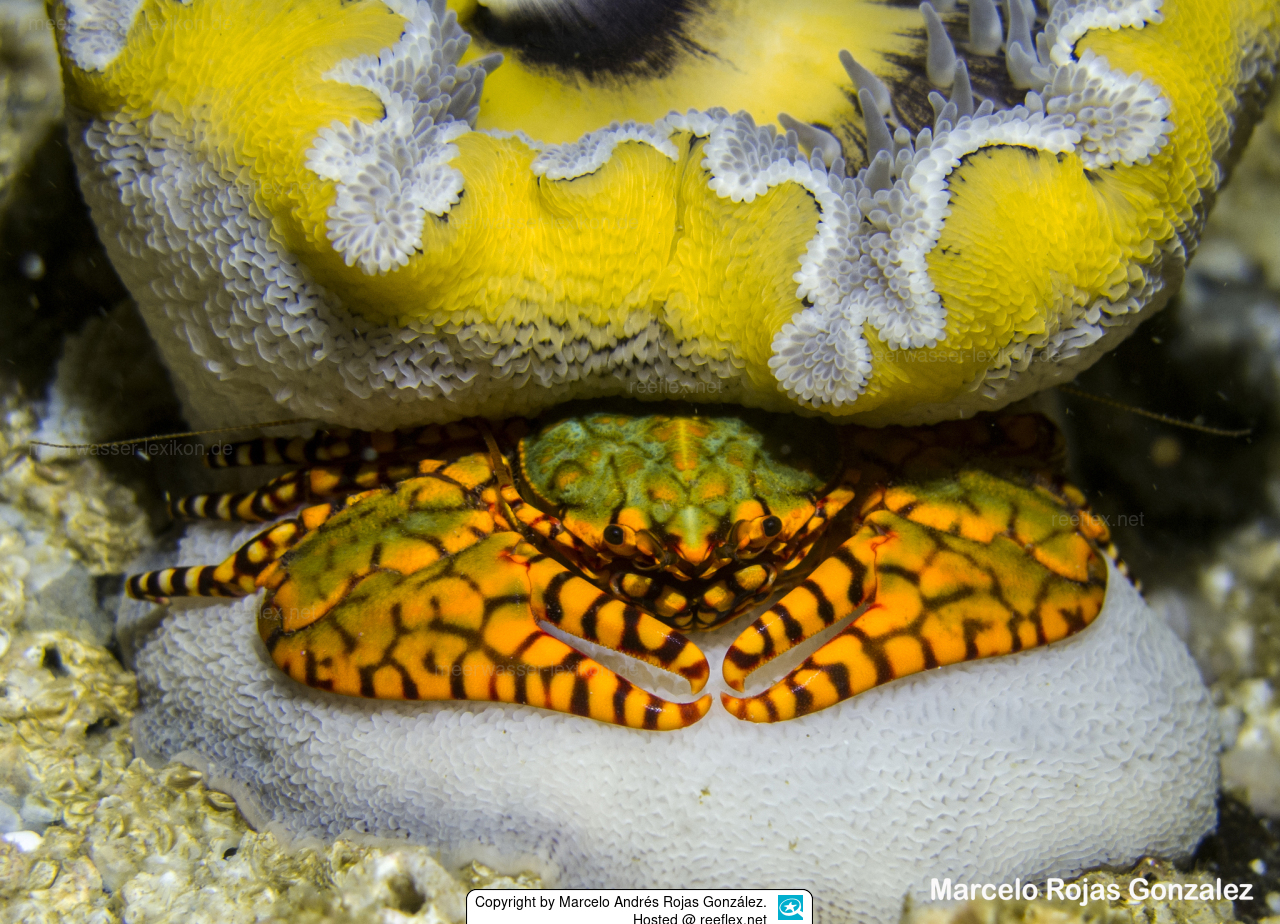
 Marcelo Andrés Rojas González, Chile

Info
Allopetrolisthes spinifrons is a small but very pretty porcelain crab native to Chile and Peru in the eastern Pacific Ocean.
The porcelain crab Allopetrolisthes spinifrons is an ectocommensal symbiont of the sea anemone Phymactis papillosa and Phymactis clematis and exhibits suspension feeding behavior related to current fluctuations and repeated changes in current direction.
The individual crabs aligned their filter appendages (third maxillipeds) so that they had a concave surface upstream and showed a higher frequency of maxilliped movements (flexion) at the beginning of the reverse current.
The crab is primarily a suspension feeder, but can also ingest the mucus and feces of its host.
Unlike free-living porcellanids, the symbiotic lifestyle provides access to exposed locations in the intertidal zone and subtidal environment that are favorable for passive suspension feeding, eliminating the need for an alternative feeding mechanism.
Allopetrolisthes spinifrons also occurs on the echinoderms Stichaster striatus Muller and Troschel, 1840, Meyenaster gelatinosus (Meyen, 1834), Heliaster helianthus
(Lamarck, 1816) and the gastropods Fissurella pulchra Sowerby, 1831, Fissurella crassa Lamarck, 1822, Fissurella cumingi Reeve, 1849, Fissurella nigra Lesson, 1831, and Concholepas concholepas (Brugie`re, 1789), as well as another species of anemone, including Phymanthea pluvia (Drayton, 1864) (Haig, 1955; Viviani, 1969; Baeza and Stotz, 1995, 2001).
The fact that all of these host species produce mucus could indicate that the mucus of the hosts may have other functions for Allopetrolisthes spinifrons than simply serving as food.
One possible explanation for the manipulation of host mucus is that the symbionts may need a layer of mucus on the sea anemones to protect themselves from attacks by their hosts.
However, it is also conceivable that the crabs are chemically camouflaged by ingesting host mucus and that cleaning movements contribute to the formation of a mucus layer. Acclimatization behavior has been proposed for several species that live symbiotically with anemones, including decapods (Levine and Blanchard, 1980) and anemonefish (Elliott et al., 1994).
An investigation of sea anemones and their host Allopetrolisthes spinifrons. yielded interesting results.
The population biology of the porcelain crab in northern central Chile was studied between January and December 1996.
In 1996, 74% of Phymactis papillosa in the rocky intertidal zone hosted at least one commensal crab.
In most cases, a sea anemone was inhabited by a single adult crab, either male or female.
A few sea anemones housed two or more crabs, one of which was usually an adult crab and the others juveniles or small crabs that had just joined the host.
The sex ratio of adult crabs was approximately 1:1 in most months.
Reproduction occurred throughout the year with similar intensity, as evidenced by the continuous presence of reproductive females.
Similarly, settlement of Allopetrolisthes spinifrons occurred throughout the year, with the exception of late winter, when no megalopae and small juveniles were found on sea anemones.
The fertility of female crabs varied between 121 and 5661 eggs per female (6.9–19.2 mm carapace length) and was significantly higher during the southern winter (July) than during the summer (December).
The fact that most sea anemones were inhabited by a single adult crab suggests that hosts may be monopolized by individual crabs.
Resource requirements may prevent adult crabs from sharing a host with another large crab, while adult tolerance of juveniles may facilitate the maintenance of local populations.
Due to the low abundance of the host, it represents a scarce and limited resource for the crab. Furthermore, the small size of the sea anemone host suggests that only a few symbiotic crabs can coexist on a single host individual, forcing the crabs to exhibit territorial behavior.
To investigate the potential presence and ontogenetic development of territoriality, agonistic behavior between crabs of different ontogenetic stages (adults, juveniles, and recruits) was studied in the laboratory.
Laboratory experiments showed that adult or juvenile crabs aggressively defended their sea anemone hosts against adult or juvenile intruders, but both adult and juvenile crabs tolerated recruits.
Adult crabs were indifferent toward juvenile crabs, sometimes tolerating them and sometimes chasing them away.
The agonistic interactions observed in the laboratory and the uniform population distribution pattern on sea anemones recently described for Allopetrolisthes spinifrons suggest that this species exhibits territorial behavior that develops during ontogeny.
The territoriality of this species and other symbiotic decapods may function as a density-dependent mechanism of population regulation mediated by host availability.
The hypothesis that the consumption of excrement (feces) may be similar to that of the mucus of host animals was also investigated.
It was noted that this seems possible, but the current would cause the feces of the host animals to drift away very quickly.
We would like to express our sincere thanks to Marcelo Andrés Rojas González from Chile, who kindly provided us with his remarkable photos!
Synonym: Porcellana spinifrons H. Milne Edwards, 1837 · unaccepted > superseded combination
The porcelain crab Allopetrolisthes spinifrons is an ectocommensal symbiont of the sea anemone Phymactis papillosa and Phymactis clematis and exhibits suspension feeding behavior related to current fluctuations and repeated changes in current direction.
The individual crabs aligned their filter appendages (third maxillipeds) so that they had a concave surface upstream and showed a higher frequency of maxilliped movements (flexion) at the beginning of the reverse current.
The crab is primarily a suspension feeder, but can also ingest the mucus and feces of its host.
Unlike free-living porcellanids, the symbiotic lifestyle provides access to exposed locations in the intertidal zone and subtidal environment that are favorable for passive suspension feeding, eliminating the need for an alternative feeding mechanism.
Allopetrolisthes spinifrons also occurs on the echinoderms Stichaster striatus Muller and Troschel, 1840, Meyenaster gelatinosus (Meyen, 1834), Heliaster helianthus
(Lamarck, 1816) and the gastropods Fissurella pulchra Sowerby, 1831, Fissurella crassa Lamarck, 1822, Fissurella cumingi Reeve, 1849, Fissurella nigra Lesson, 1831, and Concholepas concholepas (Brugie`re, 1789), as well as another species of anemone, including Phymanthea pluvia (Drayton, 1864) (Haig, 1955; Viviani, 1969; Baeza and Stotz, 1995, 2001).
The fact that all of these host species produce mucus could indicate that the mucus of the hosts may have other functions for Allopetrolisthes spinifrons than simply serving as food.
One possible explanation for the manipulation of host mucus is that the symbionts may need a layer of mucus on the sea anemones to protect themselves from attacks by their hosts.
However, it is also conceivable that the crabs are chemically camouflaged by ingesting host mucus and that cleaning movements contribute to the formation of a mucus layer. Acclimatization behavior has been proposed for several species that live symbiotically with anemones, including decapods (Levine and Blanchard, 1980) and anemonefish (Elliott et al., 1994).
An investigation of sea anemones and their host Allopetrolisthes spinifrons. yielded interesting results.
The population biology of the porcelain crab in northern central Chile was studied between January and December 1996.
In 1996, 74% of Phymactis papillosa in the rocky intertidal zone hosted at least one commensal crab.
In most cases, a sea anemone was inhabited by a single adult crab, either male or female.
A few sea anemones housed two or more crabs, one of which was usually an adult crab and the others juveniles or small crabs that had just joined the host.
The sex ratio of adult crabs was approximately 1:1 in most months.
Reproduction occurred throughout the year with similar intensity, as evidenced by the continuous presence of reproductive females.
Similarly, settlement of Allopetrolisthes spinifrons occurred throughout the year, with the exception of late winter, when no megalopae and small juveniles were found on sea anemones.
The fertility of female crabs varied between 121 and 5661 eggs per female (6.9–19.2 mm carapace length) and was significantly higher during the southern winter (July) than during the summer (December).
The fact that most sea anemones were inhabited by a single adult crab suggests that hosts may be monopolized by individual crabs.
Resource requirements may prevent adult crabs from sharing a host with another large crab, while adult tolerance of juveniles may facilitate the maintenance of local populations.
Due to the low abundance of the host, it represents a scarce and limited resource for the crab. Furthermore, the small size of the sea anemone host suggests that only a few symbiotic crabs can coexist on a single host individual, forcing the crabs to exhibit territorial behavior.
To investigate the potential presence and ontogenetic development of territoriality, agonistic behavior between crabs of different ontogenetic stages (adults, juveniles, and recruits) was studied in the laboratory.
Laboratory experiments showed that adult or juvenile crabs aggressively defended their sea anemone hosts against adult or juvenile intruders, but both adult and juvenile crabs tolerated recruits.
Adult crabs were indifferent toward juvenile crabs, sometimes tolerating them and sometimes chasing them away.
The agonistic interactions observed in the laboratory and the uniform population distribution pattern on sea anemones recently described for Allopetrolisthes spinifrons suggest that this species exhibits territorial behavior that develops during ontogeny.
The territoriality of this species and other symbiotic decapods may function as a density-dependent mechanism of population regulation mediated by host availability.
The hypothesis that the consumption of excrement (feces) may be similar to that of the mucus of host animals was also investigated.
It was noted that this seems possible, but the current would cause the feces of the host animals to drift away very quickly.
We would like to express our sincere thanks to Marcelo Andrés Rojas González from Chile, who kindly provided us with his remarkable photos!
Synonym: Porcellana spinifrons H. Milne Edwards, 1837 · unaccepted > superseded combination


