


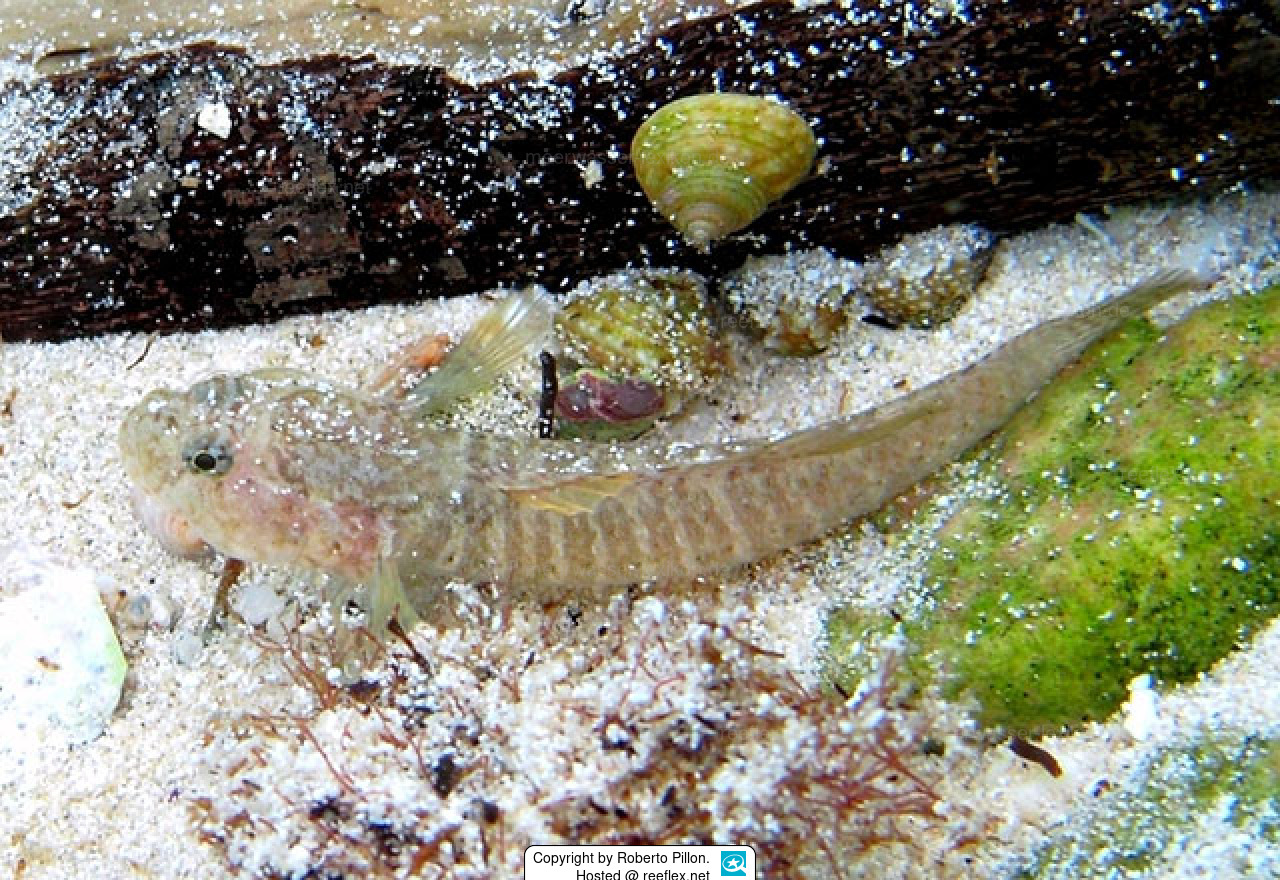
 Roberto Pillon, Italien


Info
Gobies (Gobiidae) are the most species-rich fish family in the Mediterranean and one of the most evolutionarily successful fish genera in the world's oceans.
The genus Zebrus de Buen, 1930 was established as a subgenus of Gobius to include small cryptobenthic Mediterranean gobies such as Gobius zebrus Risso, 1827 and Gobius thori de Buen, 1928, although the latter is now synonymous with Thorogobius ephippiatus (Lowe, 1839) (de Buen, 1930; Miller, 1973).
The coloration of the specimen observed in situ from Split (IOR-Zpallaoroi12021) was dark brown, almost black, with barely visible vertical stripes on the flanks that were slightly lighter than the surrounding coloration, and a conspicuous, curved light band on the head.
Very soon after capture, the darker coloration faded and the net-like brownish and yellowish pattern became visible on the back, appearing as vertical stripes on the sides.
The conspicuous light band on the head extended from the pectoral fin bases and partly also from the bases of the fin rays over the upper parts of the gill cover and connected at the coronal head area above the eyes.
Ecology. All specimens of Zebrus pallaoroi were found among gravel and small boulders in very shallow infralittoral waters, directly on the shore, at a maximum depth of 1 m.
This species is a typical cryptobenthic fish.
Note: we are currently unable to assign a gender to the photos of the species.
Etymology.
The species name dr Goby was named in honor of Armin Pallaoro, a great ichthyologist from the Institute of Oceanography and Fisheries in Split, Croatia, who sadly passed away in January 2020.
Armin selflessly shared his knowledge and field and laboratory skills in the field of fish with generations of younger Croatian colleagues who were at the beginning of their careers, including one of the authors (mk).
The genus Zebrus de Buen, 1930 was established as a subgenus of Gobius to include small cryptobenthic Mediterranean gobies such as Gobius zebrus Risso, 1827 and Gobius thori de Buen, 1928, although the latter is now synonymous with Thorogobius ephippiatus (Lowe, 1839) (de Buen, 1930; Miller, 1973).
The coloration of the specimen observed in situ from Split (IOR-Zpallaoroi12021) was dark brown, almost black, with barely visible vertical stripes on the flanks that were slightly lighter than the surrounding coloration, and a conspicuous, curved light band on the head.
Very soon after capture, the darker coloration faded and the net-like brownish and yellowish pattern became visible on the back, appearing as vertical stripes on the sides.
The conspicuous light band on the head extended from the pectoral fin bases and partly also from the bases of the fin rays over the upper parts of the gill cover and connected at the coronal head area above the eyes.
Ecology. All specimens of Zebrus pallaoroi were found among gravel and small boulders in very shallow infralittoral waters, directly on the shore, at a maximum depth of 1 m.
This species is a typical cryptobenthic fish.
Note: we are currently unable to assign a gender to the photos of the species.
Etymology.
The species name dr Goby was named in honor of Armin Pallaoro, a great ichthyologist from the Institute of Oceanography and Fisheries in Split, Croatia, who sadly passed away in January 2020.
Armin selflessly shared his knowledge and field and laboratory skills in the field of fish with generations of younger Croatian colleagues who were at the beginning of their careers, including one of the authors (mk).


