


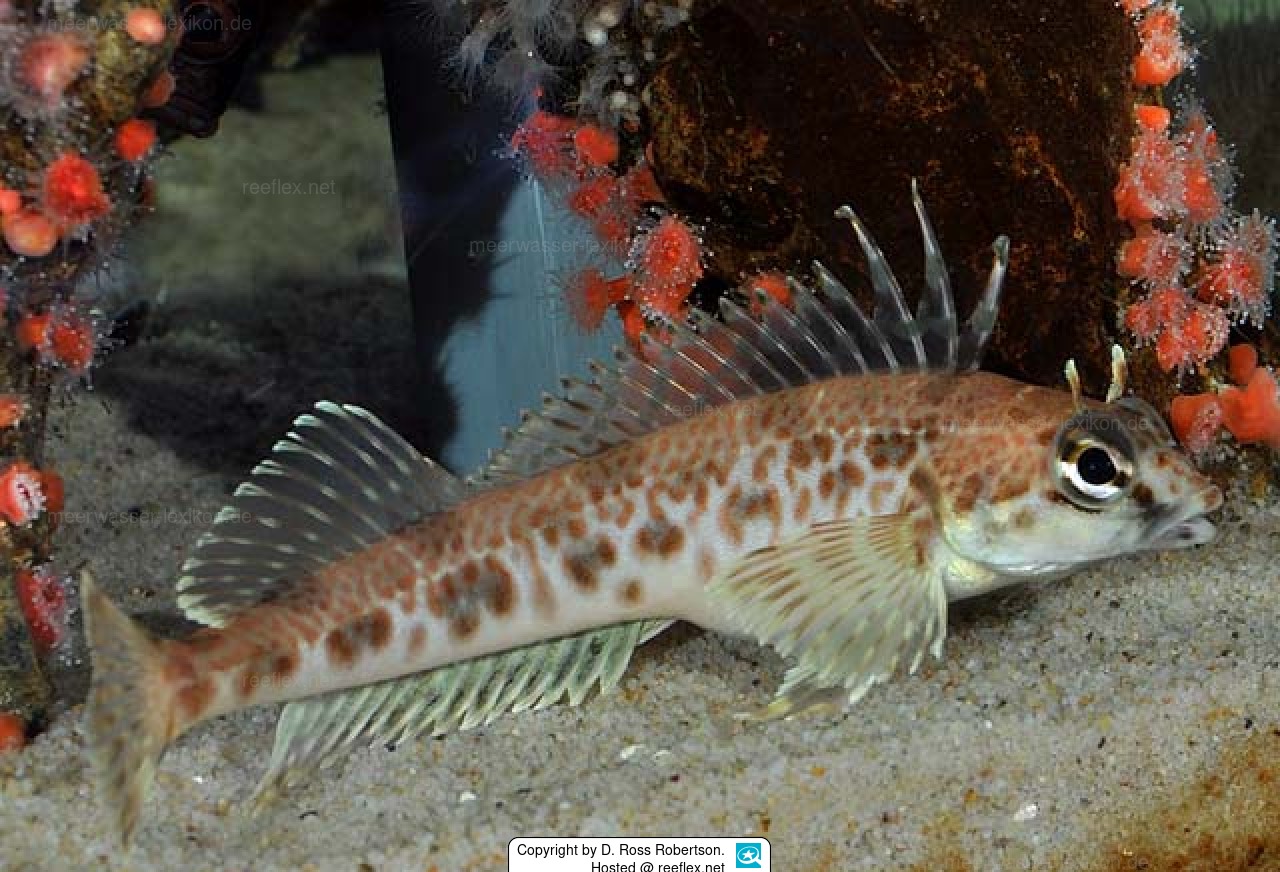
 Dr. D. Ross Robertson, Panama


Info
There has been little scientific research on Zaniolepis frenata, which is why there is only a limited amount of information available about its way of life, behavior patterns, age, growth, longevity, nutrition, use of habitat and reproduction. This would make an ideal topic for a bachelor's thesis.
The species has a very slender, elongated and stocky body.
The dorsal half of the body is light brown or pinkish with darker, diffuse markings that fade down into a white hue on the underside of the body.
The anal fin of the Short-spined Comb Green Damsel is long with a broad dark stripe and a white margin; the caudal fin is dark brown with a yellow line at the base and a yellow margin and has spines and 15 or 16 rays with a long base.
The first dorsal fin is pale with three rows of dark spots, one at the base, one in the middle and one at the edge, and it has 21 spiny rays with a long base.
Pelvic fins and pectoral fins are similar in size and color, dark brown in the middle and yellow or white at the edges,
The caudal fin is slightly rounded, the pectoral and pelvic fins are covered with small scales and rough to the touch, they are of medium length and do not reach to the base of the anal fin.
The green urchin's head is relatively short with a pointed snout and a small mouth, its eyes are set high on its head.
The shortspine combfish has a prominent lateral line that is set high on its body.
In the food chain, the shortspine combfish is an important prey for sea lions and various larger predatory fish species.
Diving seabirds also prey on the green urchin in shallower water zones.
Synonyms: Zaniolepis frenatus Eigenmann & Eigenmann, 1889 · unaccepted (misspelling)
The species has a very slender, elongated and stocky body.
The dorsal half of the body is light brown or pinkish with darker, diffuse markings that fade down into a white hue on the underside of the body.
The anal fin of the Short-spined Comb Green Damsel is long with a broad dark stripe and a white margin; the caudal fin is dark brown with a yellow line at the base and a yellow margin and has spines and 15 or 16 rays with a long base.
The first dorsal fin is pale with three rows of dark spots, one at the base, one in the middle and one at the edge, and it has 21 spiny rays with a long base.
Pelvic fins and pectoral fins are similar in size and color, dark brown in the middle and yellow or white at the edges,
The caudal fin is slightly rounded, the pectoral and pelvic fins are covered with small scales and rough to the touch, they are of medium length and do not reach to the base of the anal fin.
The green urchin's head is relatively short with a pointed snout and a small mouth, its eyes are set high on its head.
The shortspine combfish has a prominent lateral line that is set high on its body.
In the food chain, the shortspine combfish is an important prey for sea lions and various larger predatory fish species.
Diving seabirds also prey on the green urchin in shallower water zones.
Synonyms: Zaniolepis frenatus Eigenmann & Eigenmann, 1889 · unaccepted (misspelling)

