




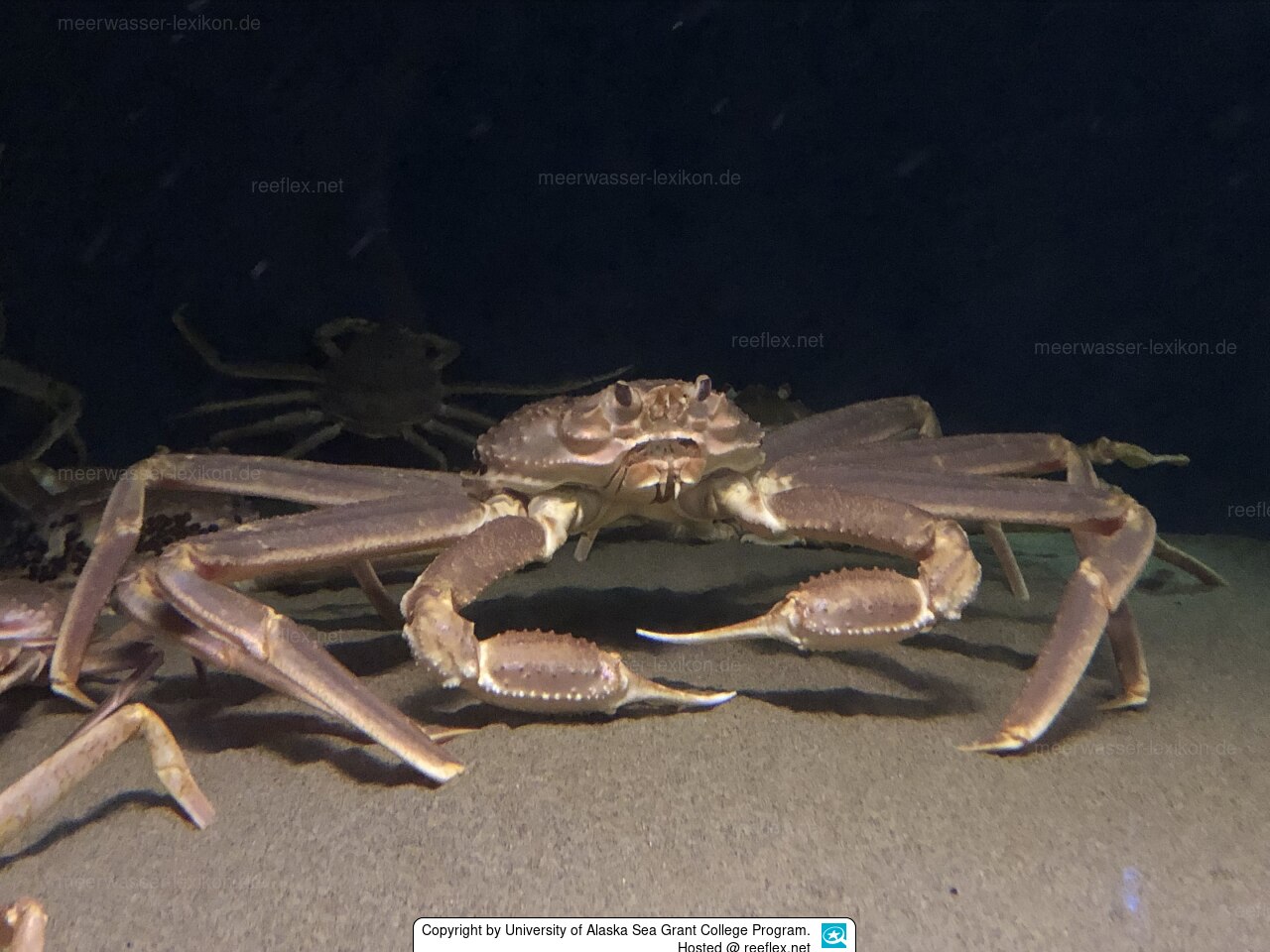
 University of Alaska Sea Grant College Program, Alaska, USA

Info
Chionoecetes opilio, as the name "snow crab" implies, is an inhabitant of very cold waters, which, however, are significantly richer in nutrients than the tropical oceans.
The crab plays an important role for humans, as it is intensively pursued through commercial fishing.
The crab itself is not a food lover, it eats everything that gets in front of its pincers.
What does the snow crab have to do with climate change?
The number of snow crabs in the Bering Sea once numbered in the billions. But after a massive recent population collapse, the crabs have all but disappeared from these waters - and they're not likely to return anytime soon.
In 2018, about 3 billion adult snow crabs (Chionoecetes opilio) lived in the Bering Sea, along with about five billion immature crabs, reports the Seattle Times (opens in new tab). But by the end of 2021, those numbers fluctuated around 2.5 million and 6.5 million, respectively - a loss of nearly eight billion crabs in just three years. In February, the National Marine Fishing Service issued an official overfishing notice (opens in a new tab) for the population, and in early October, Alaska Department of Fish and Game (ADFG) officials made the difficult decision to cancel the snow crab harvest for this season, fearing the crustaceans would be wiped out altogether
The snow crab population in the Bering Sea has been declining for the past five years, but this season the population collapsed.
What was the cause of the snow crab decline? The main culprit was almost certainly human-caused climate change, although unsustainable fishing practices may also have played a role, the Seattle Times reports.
Snow crabs thrive in the cold northern waters of the Bering Sea. For these crabs, water temperature is not just a matter of comfort; it plays a critical role in their life cycle. When seawater cools, it loses salinity and buoyancy, causing it to sink to the ocean floor. Marine biologists refer to this cool layer of water as the "cold pool," according to the National Oceanic and Atmospheric Administration (opens in new tab) (NOAA). Many fish and other types of marine life avoid the cold pool, but it is a haven for juvenile snow crabs. With virtually no predators venturing into the cold waters of this layer, the young crabs can grow up in peace.
But recently, this protection has diminished. Record heat waves in 2016, 2018 and 2019 have prevented cold pools from forming in the Bering Sea, leaving baby crabs vulnerable to predators, according to a report released Sept. 2 by NOAA (opens in new tab). In addition, Westphal said, the warmer water likely accelerated the adult crabs' metabolism, causing them to starve. As anthropogenic climate change progresses over the next few decades, these types of heat waves will become more common, according to the report.
In addition to climate change, some commercial fishing practices may have contributed to the sharp decline in crab stocks. Trawlers targeting other marine species in the Bering Sea often encounter unwanted snow crabs, catch them and discard them as "bycatch."
Sometimes the crabs survive the shock of being suddenly carried to the surface and then tossed back into the water - but often they don't. In 2020, ADFG estimated that over 30% of all snow crabs caught and discarded into the Bering Sea died.
NOAA's 2021 assessment of Bering Sea snow crabs confirmed these grim results: Snow crab mortality rates increased that year and populations declined sharply.
The change is not only affecting the fishing industry; other animals are also affected by the departure of the crabs:
The snow crab, which can grow up to 2 kilograms, is on the menu of the Northeast Arctic cod (Gadus morhua), this cod consequently has to "look around" for another food source.
Literature reference
Bibliography of Research on Snow Crab (Chionoecetes opilio)
University of Alaska Sea Grant College Program
https://seagrant.uaf.edu/lib/aksg/0001/AK-SG-00-01.pdf
https://creativecommons.org/licenses/by-sa/4.0/deed.en
The crab plays an important role for humans, as it is intensively pursued through commercial fishing.
The crab itself is not a food lover, it eats everything that gets in front of its pincers.
What does the snow crab have to do with climate change?
The number of snow crabs in the Bering Sea once numbered in the billions. But after a massive recent population collapse, the crabs have all but disappeared from these waters - and they're not likely to return anytime soon.
In 2018, about 3 billion adult snow crabs (Chionoecetes opilio) lived in the Bering Sea, along with about five billion immature crabs, reports the Seattle Times (opens in new tab). But by the end of 2021, those numbers fluctuated around 2.5 million and 6.5 million, respectively - a loss of nearly eight billion crabs in just three years. In February, the National Marine Fishing Service issued an official overfishing notice (opens in a new tab) for the population, and in early October, Alaska Department of Fish and Game (ADFG) officials made the difficult decision to cancel the snow crab harvest for this season, fearing the crustaceans would be wiped out altogether
The snow crab population in the Bering Sea has been declining for the past five years, but this season the population collapsed.
What was the cause of the snow crab decline? The main culprit was almost certainly human-caused climate change, although unsustainable fishing practices may also have played a role, the Seattle Times reports.
Snow crabs thrive in the cold northern waters of the Bering Sea. For these crabs, water temperature is not just a matter of comfort; it plays a critical role in their life cycle. When seawater cools, it loses salinity and buoyancy, causing it to sink to the ocean floor. Marine biologists refer to this cool layer of water as the "cold pool," according to the National Oceanic and Atmospheric Administration (opens in new tab) (NOAA). Many fish and other types of marine life avoid the cold pool, but it is a haven for juvenile snow crabs. With virtually no predators venturing into the cold waters of this layer, the young crabs can grow up in peace.
But recently, this protection has diminished. Record heat waves in 2016, 2018 and 2019 have prevented cold pools from forming in the Bering Sea, leaving baby crabs vulnerable to predators, according to a report released Sept. 2 by NOAA (opens in new tab). In addition, Westphal said, the warmer water likely accelerated the adult crabs' metabolism, causing them to starve. As anthropogenic climate change progresses over the next few decades, these types of heat waves will become more common, according to the report.
In addition to climate change, some commercial fishing practices may have contributed to the sharp decline in crab stocks. Trawlers targeting other marine species in the Bering Sea often encounter unwanted snow crabs, catch them and discard them as "bycatch."
Sometimes the crabs survive the shock of being suddenly carried to the surface and then tossed back into the water - but often they don't. In 2020, ADFG estimated that over 30% of all snow crabs caught and discarded into the Bering Sea died.
NOAA's 2021 assessment of Bering Sea snow crabs confirmed these grim results: Snow crab mortality rates increased that year and populations declined sharply.
The change is not only affecting the fishing industry; other animals are also affected by the departure of the crabs:
The snow crab, which can grow up to 2 kilograms, is on the menu of the Northeast Arctic cod (Gadus morhua), this cod consequently has to "look around" for another food source.
Literature reference
Bibliography of Research on Snow Crab (Chionoecetes opilio)
University of Alaska Sea Grant College Program
https://seagrant.uaf.edu/lib/aksg/0001/AK-SG-00-01.pdf
https://creativecommons.org/licenses/by-sa/4.0/deed.en


