


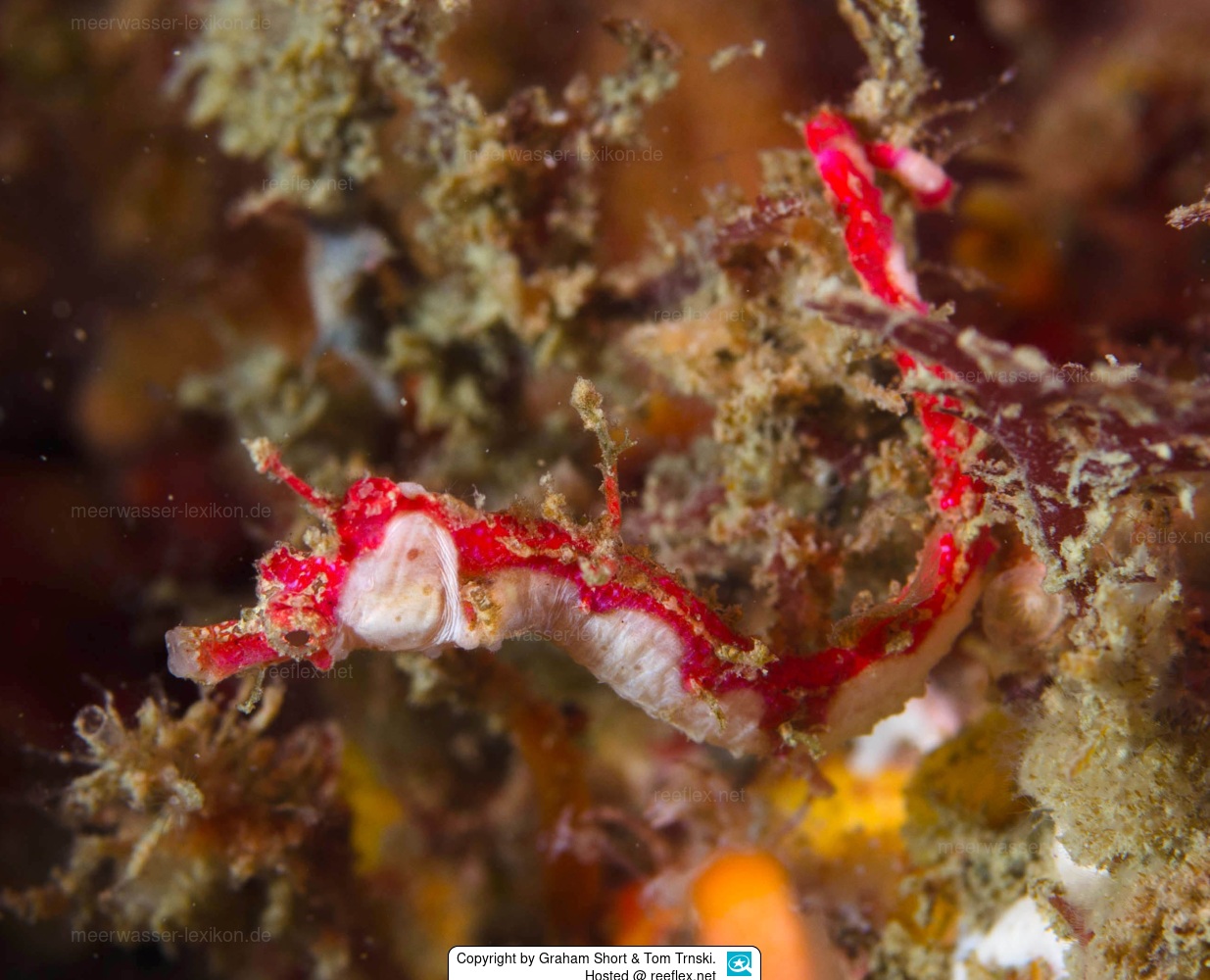
 Drs. Graham Short & Tom Trnski, USA & Neuseeland


Info
In September 2021, a special - in several respects - dwarf needle horse was first described.
We sincerely thank Dr. Graham Short, California Academy of Sciences, one of the scientists who first described the new species, for the three great photos of the new genus and species.
Among the unique features of Cylix tupareomanaia is the fact that this new pygmy needle horse originated in New Zealand, it is the first pygmy needle horse discovered in the country.
Locations of discovery: Poor Knights Island and Waiatapaua Bay, Whangaruru, Northland, New Zealand.
This is a tiny, candy-colored pygmy needle horse discovered in a small area off the north coast of New Zealand, and given a Māori name by the local iwi (tribe) - it is believed to be the first time an indigenous group has officially named a new species!
The 6 cm long animal is closely related to the seahorse and lives in the rocky reefs off the northeast coast.
The Ngātiwai tribe worked with biodiversity researchers Dr. Thomas Trnski of the Tāmaki Paenga Hira Auckland Museum and Graham Short of the California Academy of Scientists to name the pygmy seahorse Cylix tupareomanaia.
Naming:
"Cylix" is a new genus name and derives from the Greek and Latin words for "cup" or "calyx," referring to the cup-like attachment on the new species' head.
The second part of the name "tupareomanaia" refers to "the garland of manaia" - "manaia" is the Māori name for a "seahorse" and also means "ancestor" or "tupuna".
The term "reef safe" is often used in marine aquaristics, especially when buying a new species people often ask if the new animal is "reef safe".
What exactly does reef safe mean?
To answer this question, you can ask target-oriented questions and inquire in forums, clubs, dealers and with aquarist friends:
- Are there already experiences and keeping reports that assure that the new animal can live in other suitably equipped aquariums without ever having caused problems?
- Is there any experience of invertebrates (crustaceans, hermits, mussels, snails) or corals being attacked by other inhabitants such as fish of the same or a different species?
- Is any information known or expected about a possible change in dietary habits, e.g., from a plant-based diet to a meat-based diet?
- Do the desired animals leave the reef structure "alone", do they constantly change it (boring starfish, digger gobies, parrotfish, triggerfish) and thus disturb or displace other co-inhabitants?
- do new animals tend to get diseases repeatedly and very quickly and can they be treated?
- Do known peaceful animals change their character in the course of their life and become aggressive?
- Can the death of a new animal possibly even lead to the death of the rest of the stock through poisoning (possible with some species of sea cucumbers)?
- Last but not least the keeper of the animals has to be included in the "reef safety", there are actively poisonous, passively poisonous animals, animals that have dangerous biting or stinging weapons, animals with extremely strong nettle poisons, these have to be (er)known and a plan of action should have been made in advance in case of an attack on the aquarist (e.g. telephone numbers of the poison control center, the treating doctor, the tropical institute etc.).
If all questions are evaluated positively in the sense of the animal(s) and the keeper, then one can assume a "reef safety".
We sincerely thank Dr. Graham Short, California Academy of Sciences, one of the scientists who first described the new species, for the three great photos of the new genus and species.
Among the unique features of Cylix tupareomanaia is the fact that this new pygmy needle horse originated in New Zealand, it is the first pygmy needle horse discovered in the country.
Locations of discovery: Poor Knights Island and Waiatapaua Bay, Whangaruru, Northland, New Zealand.
This is a tiny, candy-colored pygmy needle horse discovered in a small area off the north coast of New Zealand, and given a Māori name by the local iwi (tribe) - it is believed to be the first time an indigenous group has officially named a new species!
The 6 cm long animal is closely related to the seahorse and lives in the rocky reefs off the northeast coast.
The Ngātiwai tribe worked with biodiversity researchers Dr. Thomas Trnski of the Tāmaki Paenga Hira Auckland Museum and Graham Short of the California Academy of Scientists to name the pygmy seahorse Cylix tupareomanaia.
Naming:
"Cylix" is a new genus name and derives from the Greek and Latin words for "cup" or "calyx," referring to the cup-like attachment on the new species' head.
The second part of the name "tupareomanaia" refers to "the garland of manaia" - "manaia" is the Māori name for a "seahorse" and also means "ancestor" or "tupuna".
The term "reef safe" is often used in marine aquaristics, especially when buying a new species people often ask if the new animal is "reef safe".
What exactly does reef safe mean?
To answer this question, you can ask target-oriented questions and inquire in forums, clubs, dealers and with aquarist friends:
- Are there already experiences and keeping reports that assure that the new animal can live in other suitably equipped aquariums without ever having caused problems?
- Is there any experience of invertebrates (crustaceans, hermits, mussels, snails) or corals being attacked by other inhabitants such as fish of the same or a different species?
- Is any information known or expected about a possible change in dietary habits, e.g., from a plant-based diet to a meat-based diet?
- Do the desired animals leave the reef structure "alone", do they constantly change it (boring starfish, digger gobies, parrotfish, triggerfish) and thus disturb or displace other co-inhabitants?
- do new animals tend to get diseases repeatedly and very quickly and can they be treated?
- Do known peaceful animals change their character in the course of their life and become aggressive?
- Can the death of a new animal possibly even lead to the death of the rest of the stock through poisoning (possible with some species of sea cucumbers)?
- Last but not least the keeper of the animals has to be included in the "reef safety", there are actively poisonous, passively poisonous animals, animals that have dangerous biting or stinging weapons, animals with extremely strong nettle poisons, these have to be (er)known and a plan of action should have been made in advance in case of an attack on the aquarist (e.g. telephone numbers of the poison control center, the treating doctor, the tropical institute etc.).
If all questions are evaluated positively in the sense of the animal(s) and the keeper, then one can assume a "reef safety".


