Anzeige
Korallenriff Banner

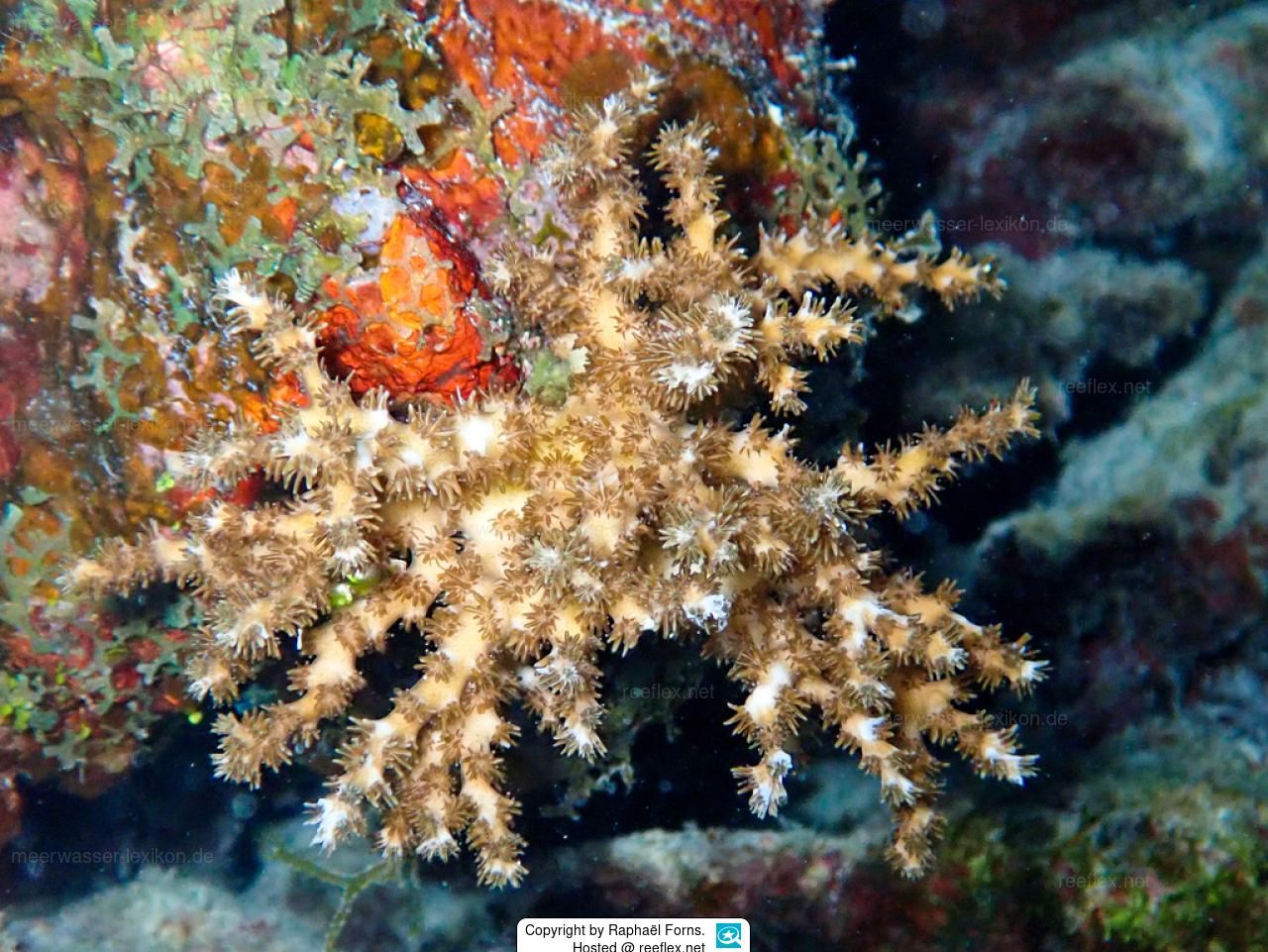
Galaxea horrescens Stony Coral

Galaxea horrescens is commonly referred to as Stony Coral. Difficulty in the aquarium: There are no reports available yet that this animal has already been kept in captivity successfully. A aquarium size of at least 150 Liter is recommended. Toxicity: Toxic hazard unknown.


Profilbild Urheber Raphaël Forns, Kanada

Galaxea horrescens, Maloelap Atoll, RMI 2023 (CC BY-NC 4.0)


Courtesy of the author Raphaël Forns, Kanada Raphaël Forns (CC BY-NC 4.0). Please visit www.inaturalist.org for more information.

Uploaded by Muelly.

Image detail


Profile

lexID:
1183 
AphiaID:
707460 
Scientific:
Galaxea horrescens 
German:
Stachelige Galaxea, Großpolypige Steinkoralle 
English:
Stony Coral 
Category:
Steenkoralen LPS 
Family tree:
Animalia (Kingdom) > Cnidaria (Phylum) > Anthozoa (Class) > Scleractinia (Order) > Euphylliidae (Family) > Galaxea (Genus) > horrescens (Species) 
Initial determination:
(Dana, ), 1846 
Occurrence:
Andaman and Nicobar Islands, Arafura Sea, Australia, Coral sea (Eastern Australia), Fiji, Great Barrier Reef, Guam, Indonesia, Japan, Kiribati, Malaysia, Marschall Islands, Micronesia, Nauru, New Caledonia, New South Wales (Australia), Niue, Northern Mariana Islands, Northern Territory (Australia), Palau, Papua New Guinea, Philippines, Queensland (Australia), Samoa, Singapore, Solomon Islands, South China Sea, Taiwan, Tasman Sea, Thailand, The Bangai Archipelago, Togean Islands, Tokelau, Tonga, Tuvalu, United States Minor Outlying Islands, Vanuatu, Wallis and Futuna, Western Australia 
Marine Zone:
Subtidal, sublittoral, infralittoral, deep zone of the oceans from the lower limit of the intertidal zone (intertidal) to the shelf edge at about 200 m water depth. neritic. 
Sea depth:
0 - 40 Meter 
Habitats:
Reef-associated, Seawater, Sea water, Turbulent flow zones 
Size:
up to 11.81" (30 cm) 
Temperature:
75.2 °F - 84.2 °F (24°C - 29°C) 
Food:
Dissolved inorganic substances) f.e.NaCL,CA, Mag, K, I.P, CO2, Dissolved organic substances, Plankton, Zooxanthellae / Light 
Tank:
33 gal (~ 150L)  
Difficulty:
There are no reports available yet that this animal has already been kept in captivity successfully 
Offspring:
Possible to breed 
Toxicity:
Toxic hazard unknown 
CITES:
Appendix II ((commercial trade possible after a safety assessment by the exporting country)) 
Red List:
Least concern (LC)  
Related species at
Catalog of Life
:
 
More related species
in this lexicon
:
 
Author:
Publisher:
Meerwasser-Lexikon.de
Created:
Last edit:
2026-03-28 13:44:32 

Captive breeding / propagation

The offspring of Galaxea horrescens are possible. Unfortunately, the number of offspring is not large enough to cover the demand of the trade. If you are interested in Galaxea horrescens, please ask your dealer for offspring. If you already own Galaxea horrescens, try breeding yourself. This will help to improve the availability of offspring in the trade and to conserve natural stocks.

Info

Galaxea horrescens Dana, 1846

Description: Colonies are arborescent. Corallites are tubular and thin walled with flaring rims. Columellae are absent. Septa are very exsert. Tentacles are usually extended only at night. They have tapering translucent tentacles with white tips.

Color: Pale brown, yellow or green, sometimes with white branch ends.

Habitat: Usually found in reef areas with good water circulation and light availability.

Abundance: Uncommon.

Similar Species: Galaxea acrhelia.

Synonymised names
Acrhelia horrescens (Dana, 1846) · unaccepted > superseded combination
Acrhelia sebae Milne Edwards & Haime, 1849 · unaccepted > junior subjective synonym
Acrohelia horrescens (Dana, 1846) · unaccepted > superseded combination
Oculina horrescens Dana, 1846 · unaccepted > superseded combination (basionym)

External links

  1. Corals of the World (en). Abgerufen am 23.12.2021.

Pictures

Commonly


Husbandry know-how of owners

am 02.06.17#1
Ich halte die Koralle seit Jahren und sie ist nach meinen Erfahrungen extrem robust und wächst auch in tieferen Zonen. Auch die Vermehrung sowie die Vergesellschaftung mit SPS (Acropora) war bisher problemlos. Sie wächst aber sehr langsam und bricht leicht ab. Man sollte sie gut befestigen, da sich nur ganz kleine Ableger von selber am Riffgestein festsetzen.

Gut haltbar!
1 husbandary tips from our users available
Show all and discuss